

What is really the sharpest knife in the world
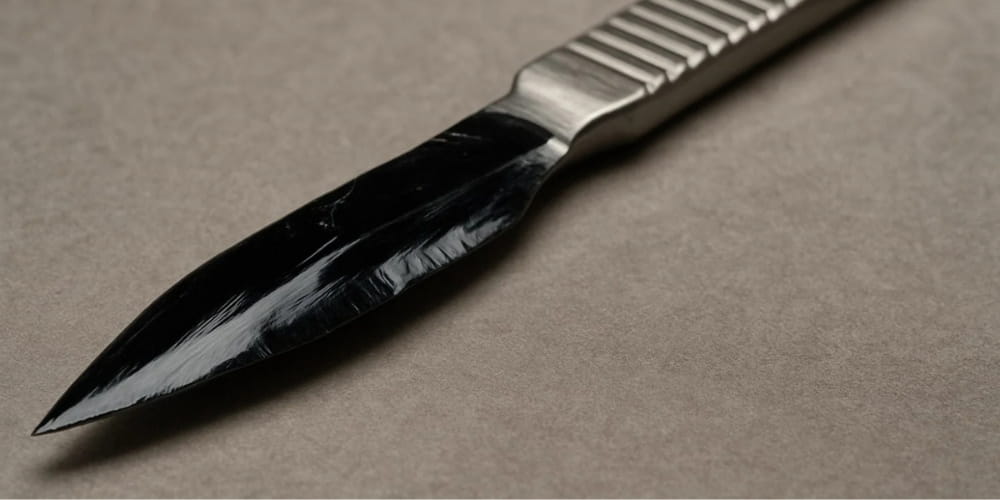
In terms of absolute sharpness, the obsidian scalpel (volcanic rock) is the sharpest, with an edge of only 3 nanometers, surpassing steel. For practical use, high-end Japanese knives (VG-10, SG2 steel) are considered the sharpest, sharpened using the traditional Honbazuke method.
Obsidian: Nanoscale Sharpness
Obsidian represents the absolute threshold of cutting fineness. This volcanic rock allows for the creation of edges as thin as 3 nanometers, far exceeding the precision of surgical steel. While technically unmatched for ultra-specialized applications, this material remains extremely fragile, making its use incompatible with culinary demands.


Excellence in Japanese Cutlery
For practical and high-performance use, Japanese knives made of high-hardness steel (VG-10, SG2) are the global benchmark. Sharpened using the traditional Honbazuke method, they feature a reduced attack angle (15-17°). This specific geometry, coupled with high steel hardness, allows for a clean penetration of food with surgical precision.
Quantitative Measurement of Sharpness: BESS Scale
The subjectivity of sharpness is standardized by the BESS system (Brubacher Edge Sharpness Scale). This metric measures in grams the force required to cut a calibrated medium. The lower the BESS value, the more effective the edge is deemed. This protocol provides an objective basis for comparison between different types of steel and sharpening.
Summary: Surgical vs. Practical Use
The choice of a tool depends on the required sharpness-durability ratio. Obsidian dominates absolute sharpness, ideal for molecular precision, but unsuitable for mechanical stress. Conversely, artisanal Japanese knives optimize sharpness for culinary ergonomics, offering a superior balance between edge durability, impact resistance, and cutting performance.

%20is%20the%20sharpest,%20with%20an%20edge%20of%20only%203%20nanometers,%20surpassing%20steel.%20For%20practical%20use,%20high-end%20Japanese%20knives%20(VG-10,%20SG2%20st...)
This site is protected by hCaptcha and the hCaptcha Privacy Policy and Terms of Service apply.