

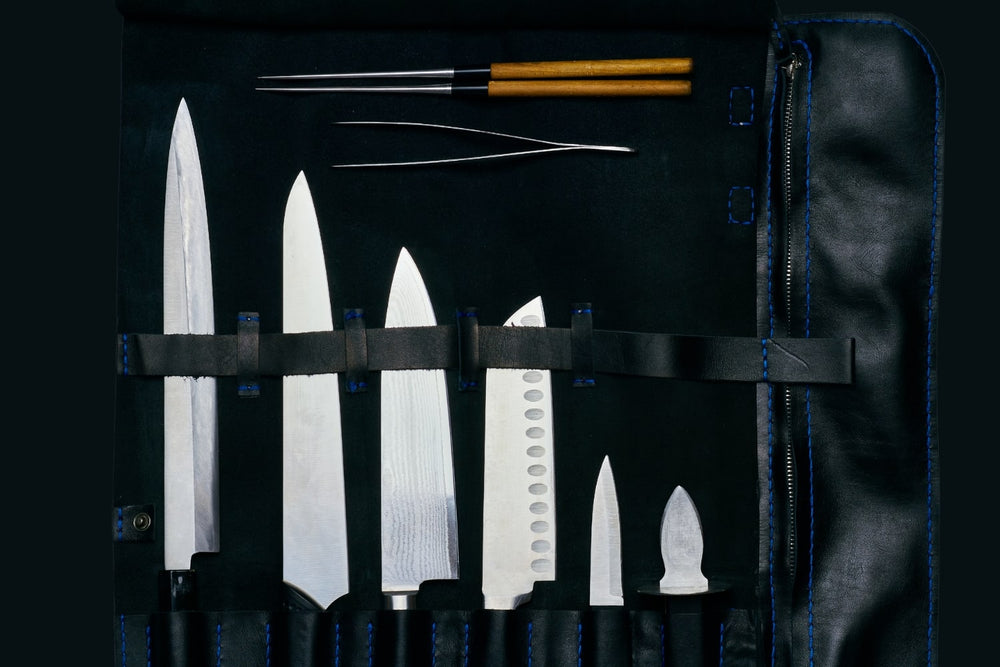
Types of Japanese knives and their uses
The world of Japanese knives is impressively rich and diverse, each blade the product of ancestral know-how and a design conceived for a specific use. Understanding the different types of Japanese knives and their uses allows you not only to choose the tool best suited to your needs, but also to appreciate the philosophy of Japanese cuisine, which focuses on precision and respect for the ingredients.
Japanese knives can be classified into major families according to their primary function. A fundamental distinction must also be made between symmetrical blades (Ryōba) , beveled on both sides like most Western knives, and asymmetrical blades (Kataba) , beveled on only one side, offering unparalleled cutting precision and traditionally designed for right-handed users.
Versatile Japanese knives
These knives are the most versatile and often recommended for starting a collection . They are designed to excel in most everyday tasks: mincing vegetables, slicing meat, and preparing fish.
| Kind | Description | Features |
| Santoku (三徳) | Meaning "three virtues" (cutting, slicing, chopping), it is the quintessential all-purpose knife in Japanese households. Shorter than a chef's knife, its wide blade with a slightly curved tip is ideal for a vertical cutting motion. | Blade: 16-18 cm, wide, curved point. Bevel: Double (Ryōba). Ideal for: Beginners, home cooking, vegetables, meat and fish. |
| Gyuto (牛刀) | Literally "beef blade," it's the Japanese equivalent of the Western chef's knife. Its longer, sharper blade allows for a smooth rocking motion, making it perfect for slicing larger pieces of meat and mincing quickly. | Blade: 18-27 cm, more curved profile, sharp point. Bevel: Double (Ryōba). Ideal for: Chefs, discerning amateurs, meats, large vegetables. |
| Bunka (文化) | Very similar to the Santoku in terms of versatility, the Bunka is distinguished by its "K-tip" (reverse Kiritsuke) point, which is extremely precise for detail work and small cuts. | Blade: 16-18 cm, reverse beveled point. Bevel: Double (Ryōba). Ideal for: Those who appreciate the aesthetics and precision of the point. |


Plant specialists
Since Japanese cuisine places vegetables at its center, there are types of Japanese knives entirely dedicated to their preparation.
| Kind | Description | Features |
| Nakiri (菜切) | Recognizable by its rectangular shape, the Nakiri is designed to cut vegetables with a clean, vertical motion, without the need to push or pull. Its wide blade makes it easy to retrieve the cut food from the board. | Blade: 16-18 cm, rectangular, very thin. Bevel: Double (Ryōba). Ideal for: Slicing, chopping, and julienne all vegetables. |
| Usuba (薄刃) | Meaning "thin blade", the Usuba is the traditional and professional version of the Nakiri. Its single-bevel blade allows for extremely fine and precise cuts, ideal for decorative techniques (katsuramuki). | Blade: 16-21 cm, rectangular. Bevel: Single (Kataba). Ideal for: Professional chefs, decorative vegetable cuts. |
Fish and meat experts
Preparing raw fish (sashimi, sushi) and meat requires specific tools to preserve the delicate texture of the flesh.
| Kind | Description | Features |
| Deba (出刃) | It's a heavy, robust knife with a thick blade, designed for the initial preparation of fish. It allows you to cut off heads, fillet fish, and get through fine bones without damaging the blade. | Blade: 15-22 cm, thick, heavy. Bevel: Single (Kataba). Ideal for: Gutting, filleting, and skinning whole fish. |
| Yanagiba (柳刃) | Meaning "willow leaf blade," this is THE sashimi knife. Its long, thin blade allows you to slice fish fillets in one continuous motion, creating a smooth, shiny cutting surface that preserves the flavor. | Blade: 21-30 cm, long, thin, rigid. Bevel: Single (Kataba). Ideal for: Cutting sashimi and sushi. |
| Sujihiki (筋引) | It's the equivalent of the Yanagiba, but with a double bevel. Less specialized, it's excellent for thinly slicing large pieces of cooked or raw meat (roasts, hams) and for filleting fish. | Blade: 21-30 cm, long, thin. Bevel: Double (Ryōba). Ideal for: Slicing meat, cutting carpaccio. |
Utility and specialty knives
Beyond these main categories, there are other types of Japanese knives for more specific tasks.
- Petty: The equivalent of our paring knife. Small, agile and precise, it is perfect for peeling, chopping herbs and making small hand cuts.
- Honesuki: A boning knife, particularly suited to poultry, with a rigid triangular blade and a sharp point for working around bones and joints.
- Kiritsuke: Historically reserved for the chef, the Kiritsuke is a versatile knife that combines the length of the Yanagiba and the height of the Usuba, with a Tanto-style point. It is available in single or double beveled versions.
The choice of a Japanese knife will therefore depend entirely on its intended use. For everyday use, a Santoku or a Gyuto is an excellent starting point. For those passionate about vegetarian cuisine, the Nakiri will transform your cooking experience. Finally, for fish lovers, the precision of a Deba or a Yanagiba is simply unparalleled.



This site is protected by hCaptcha and the hCaptcha Privacy Policy and Terms of Service apply.