

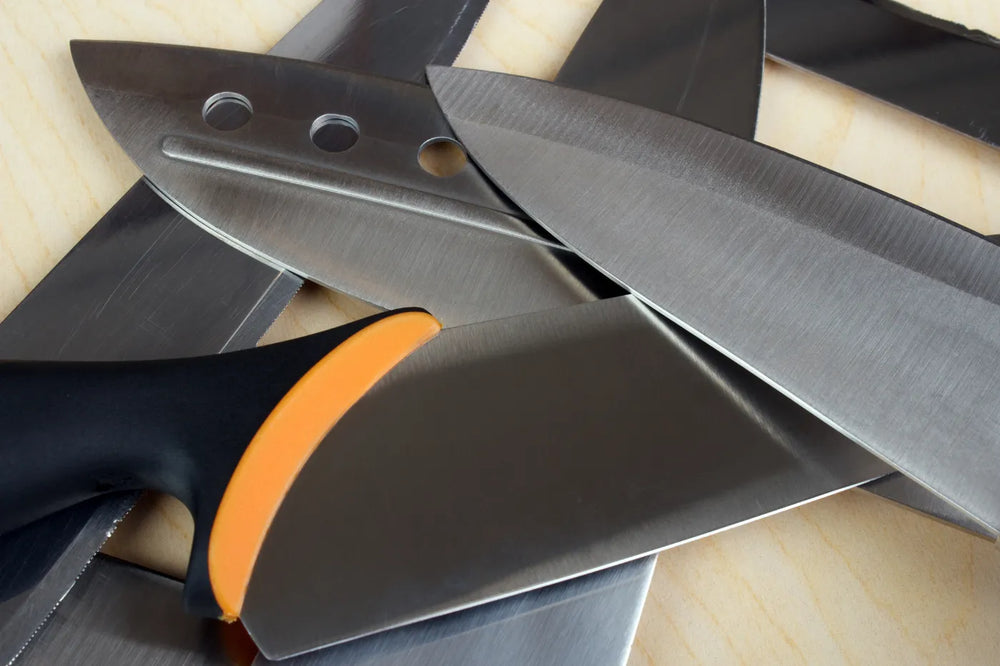
Rockwell HRC hardness of knife steels
The Rockwell HRC hardness of knife steels ranges from 52 to 65 HRC. European steels, typically between 56 and 58 HRC, offer balance and robustness. Japanese steels, often 60–62 HRC, guarantee a durable but more fragile edge, requiring careful maintenance and proper sharpening.
Are you interested in the Rockwell HRC hardness of knife steels? It's one of the essential criteria for understanding the quality of a blade. Behind this mysterious number lie strength, sharpness, and durability.
In this article, we'll decode Rockwell HRC hardness, explain how it's measured, and see how it affects everyday knife choices. You'll also find a comparison chart of common hardness ratings and tips for selecting the right steel for your cooking needs.
What is Rockwell HRC hardness?
Before choosing a knife , it's important to understand what this mysterious number really says about the steel. Rockwell hardness (HRC) is a measure of a steel's resistance to deformation. The higher the number, the harder the steel. This hardness is tested by driving a conical point into the metal and measuring the depth of penetration.
- Rockwell: the name of the method.
- HRC: the scale used, adapted for hardened steels.
- Value (example: 58 HRC): the result obtained, a direct indicator of the knife's strength.


Why HRC hardness is important
Behind an HRC value lies the safety, precision, and durability of your knives. Understanding the Rockwell HRC hardness of knife steels allows you to anticipate their performance.
- Edge retention: the harder the steel, the longer it retains its sharpness.
- Ease of sharpening: softer steel resharpenes quickly, but dulls rapidly.
- Impact resistance: steel that is too hard can become brittle.
Adaptation to use: intensive cooking, precision, cutting hard products… each use requires a balance.
The ideal beach for kitchen knives
Each hardness range corresponds to a style of knife and a way of cooking.
- 52–55 HRC: soft steel, easy to sharpen but dulls quickly. Suitable for service or entry-level knives.
- 56–58 HRC: a good compromise between a durable edge and ease of maintenance. The standard for many European knives.
- 59–61 HRC: clean and durable edge, often found on Japanese knives. Requires a little more care when sharpening.
- 62+ HRC: very hard steels, extremely sharp but with increased fragility. Reserved for high-end and specialized knives.
How hardness is measured in practice
Behind a simple number lies a rigorous and precise scientific method . The Rockwell test involves applying a standardized force to a diamond point that penetrates the blade. The depth of penetration is then translated into an HRC value.
- Rockwell tester: specific machine.
- Applied load: 150 kgf (standard for HRC).
- Result: expressed as a single number, e.g. 60 HRC.
It is a reliable measurement, but it must be considered in relation to other criteria such as the composition of the steel and the heat treatment.
The advantages of harder steel
The harder the steel, the better it retains a fine and precise edge over time. A knife with a hardness of 60 HRC or higher offers:
- A finer and more precise cutting edge.
- Extended cutting time.
- Fewer resharpenings required.
Ideal for thin cuts such as sashimi or carpaccio.
The limits of excessively hard steel
High hardness also has its disadvantages that you should be aware of.
- Fragility: risk of chipping if cutting bones or foods that are too hard.
- Sharpening is more difficult: it requires suitable stones and some technique.
- Less tolerant: cutting errors are punished more quickly.
Comparative table of Rockwell HRC hardness
A visual chart helps to easily compare hardness ranges and their uses.
| Hardness (HRC) | Type of use | Benefits | Boundaries |
|---|---|---|---|
| 52–55 | Entry-level knives | Easy to sharpen | They become blunt quickly |
| 56–58 | European knives | Good balance | Less sharp than the Japanese |
| 59–61 | Japanese knives | Durable cutting edge | More difficult to sharpen |
| 62–65 | High-end knives | Exceptional razor-sharp edge | Brittle, fragile to impacts |
Choose the hardness according to your needs
Your cooking style determines the correct Rockwell HRC hardness level.
- Daily use, family: opt for 56–58 HRC for ease of use.
- Passion for cooking, precision: opt for 59–61 HRC for edge retention.
- Collection or specialty: explore 62+ HRC, with particular care.
How to care for a knife according to its hardness
Each type of steel hardness requires a specific maintenance method.
- Soft steel (52–55 HRC): sharpen regularly with a honing steel, avoid heavy tasks.
- Medium steel (56–58 HRC): balanced maintenance, medium grit stone every month.
- Hardened steel (59+ HRC): fine stone or ceramic, be careful of impacts.
Common steels and their HRC hardness
A few references to well-known steels allow us to quickly situate their performance.
- X50CrMoV15 (European): 56-58 HRC.
- VG-10 (Japanese): 60–61 HRC.
- AUS-8 (Japanese): 57–59 HRC.
- ZDP-189 (Japanese high-end): 64–65 HRC.
Mistakes to avoid with knives that are too hard
Very hard steel requires more vigilance on a daily basis.
- Cut frozen food.
- Place the knife on marble or glass.
- To force a bone or a thick fishbone.
- Let the blade fall.
European knives vs. Japanese knives
Two culinary philosophies are expressed in the hardness of their steels.
- European (56–58 HRC): robust, easy to sharpen, more forgiving.
- Japanese (60+ HRC): extreme cut, surgical precision, but fragile.
The choice depends on your cooking style and your tolerance for maintenance.
The Rockwell HRC hardness of knife steels is more than just a number: it's a valuable indicator of performance. It guides you towards the knife that best suits your needs, balancing ease of maintenance with cutting precision.
In summary: for versatility, choose around 56–58 HRC. For a lasting edge, opt for 59–61 HRC. For ultimate enjoyment, explore steels beyond 62 HRC. Your knife will become a precise and durable ally.
FAQ
What is Rockwell HRC hardness?
It's a measure of steel strength. Rockwell HRC hardness indicates the strength and quality of a kitchen knife.
What HRC hardness rating is required for a kitchen knife?
Between 56 and 61 HRC depending on your needs. The Rockwell HRC hardness of knife steels determines sharpness and durability.
Is harder steel always better?
No. Too high a Rockwell HRC hardness makes the steel brittle, even if the cutting edge is more durable and precise.
How can I determine the hardness of my knife?
It is often indicated by the manufacturer. The Rockwell HRC hardness of knife steels is generally between 55 and 62.
Why do Japanese knives have a higher hardness?
Because their steel is richer in carbon. The Rockwell HRC hardness of steels for Japanese knives often exceeds 60.


This site is protected by hCaptcha and the hCaptcha Privacy Policy and Terms of Service apply.