

ETCH vs Opinel Kitchen Knives: A Complete Comparison
In the demanding world of cooking, choosing a knife is a crucial decision. Two brands, one steeped in history, the other more recent and with a sleek design, stand out on the French market: Opinel and ETCH . While Opinel relies on its century-old heritage and reputation for robustness, ETCH focuses on a modern approach, combining minimalist design with artisanal quality. But which of these two manufacturers offers the best tool for the amateur or professional cook? Let's delve into a sharp duel to decide between them.
Brand Manufacturing and Philosophy
Opinel: Tradition at the Service of Utility
Opinel is a cornerstone of French cutlery, synonymous with reliability and simplicity. Founded in 1890, the brand has adapted over the decades without ever abandoning its Savoyard roots. Its manufacturing, entirely in France, relies on time-tested methods, resulting in robust and affordable knives. Opinel's philosophy is clear: to offer a functional, durable, and unpretentious tool, true to the popular spirit of its famous pocket knives.
ETCH: The Marriage of Craftsmanship and Design
ETCH is a newer brand, born from a desire to combine the ancestral know-how of Thiers cutlery with contemporary design. Their knives are the result of a collaboration between a Parisian designer and a family-run cutlery workshop. ETCH's philosophy focuses on three pillars: sharpness, aesthetics, and durability. The goal is to create tools that are not only high-performing but also beautiful objects, inspiring the pleasure of cooking.


Blade Materials and Quality
Opinel: Practical Steel and the Iconic Beech
Opinel primarily uses Sandvik 12C27 stainless steel for its blades, a material renowned for its excellent balance between corrosion resistance and ease of sharpening. This quality makes Opinel kitchen knives very practical for everyday use and requires minimal maintenance. The handles are most often made of varnished beechwood, a traditional and ergonomic choice, although some modern ranges opt for polymer.
ETCH: Premium Steel and Characterful Wood
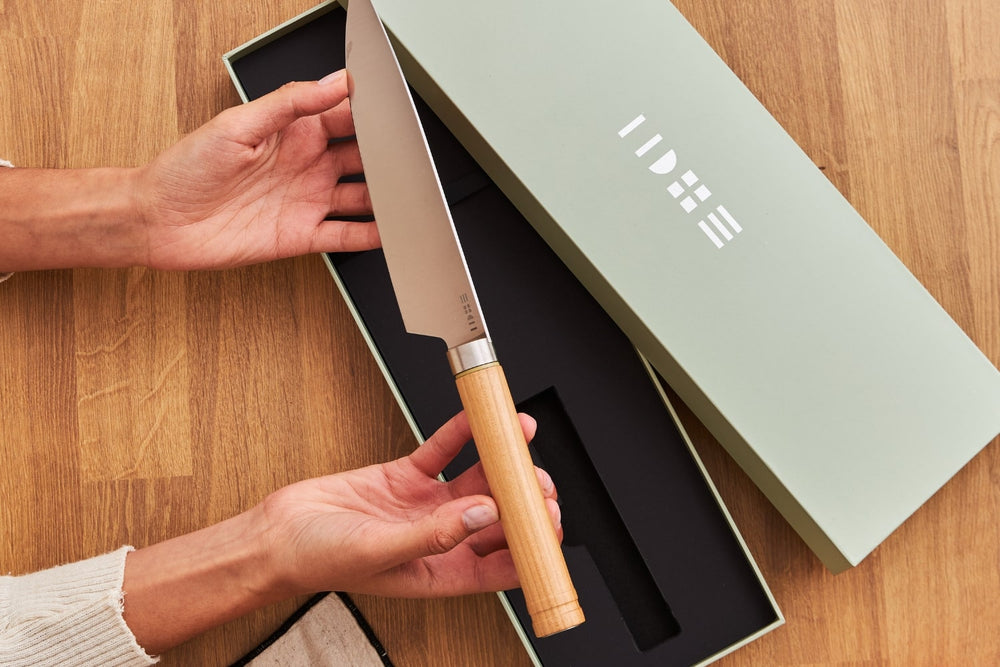
ETCH stands out thanks to its use of Nitrox® steel , a stainless steel whose hardness (58 HRC) guarantees a longer-lasting edge than that of a standard Opinel. This superior steel quality allows for more precise cutting and better edge retention. The handles, made of French cherry wood , are not merely an aesthetic choice: this durable and elegant wood reinforces the premium character of each piece.
Design and Ergonomics
Opinel: The Simplicity of Tradition
Opinel's design is first and foremost functional. Collections like "Parallèle" and "Intempora" are characterized by simple lines and proven ergonomics, prioritizing user comfort. The aesthetic remains understated, almost utilitarian, emphasizing the robustness of the wood and the practicality of the form.
ETCH: Japanese-Influenced Minimalism
The design of ETCH knives is clearly inspired by Japanese forms. The lines are clean, and the round handle offers a unique grip, optimized for dexterity. This knife is more than just a tool; it's a decorative object, adding a touch of refinement to the kitchen. The attention to detail, such as the dimpled blade of the Santoku, demonstrates a focus on craftsmanship that goes beyond mere functionality.
Comparative Table: ETCH vs. Opinel
| Criteria | ETCH | Opinel |
|---|---|---|
| Origin of the brand | French (Paris & Thiers) | French (Savoie & Thiers) |
| Philosophy | Minimalist and contemporary design , combining aesthetics and performance . | Tradition and functionality , symbols of robustness and simplicity . |
| Blade steel | Nitrox® stainless steel (58 HRC) | Sandvik 12C27 or X50CrMoV15 stainless steel |
| Blade hardness | High (58 HRC), for a durable edge and better resistance. | Medium, for easy sharpening and good corrosion resistance. |
| Handle material | French cherry wood (varnished) | Beech wood (varnished) or polymer |
| Design | Sleek, Japanese-inspired , with a round handle for dexterity. | Traditional and functional, with simple lines and proven ergonomics. |
| Price | Generally higher , reflecting the high-end positioning and craftsmanship. | More affordable , with excellent value for money. |
| Target audience | Passionate about cooking and lovers of beautiful objects, looking for a high-quality tool . | Suitable for the general public, for everyday use and for those who appreciate reliable values and tradition. |
Verdict: Which one is the best?
There is no absolute winner, but rather a choice that depends on the user's priorities.
- Choose Opinel if: You are looking for a reliable, robust, and easy-to-maintain kitchen knife. Opinel is a safe choice, perfect for everyday use, with excellent value for money. It embodies a proven heritage and tradition.
- Choose ETCH if: You are passionate about cooking, looking for a high-quality tool that offers superior cutting performance and a refined design. ETCH knives are an investment in an object that is both high-performing, durable, and aesthetically pleasing. It's the choice of those who want to combine the pleasure of cutting with the art of fine dining.
In conclusion, Opinel is the knife of pragmatism, the one that will never disappoint and is part of a long history of French cutlery. ETCH , on the other hand, is the knife of pleasure, the one that transforms the chore of cutting into a moment of pure bliss, with the promise of exceptional performance and design. The best knife is the one that best suits your hand, your cooking style, and ultimately, your heart.


This site is protected by hCaptcha and the hCaptcha Privacy Policy and Terms of Service apply.