

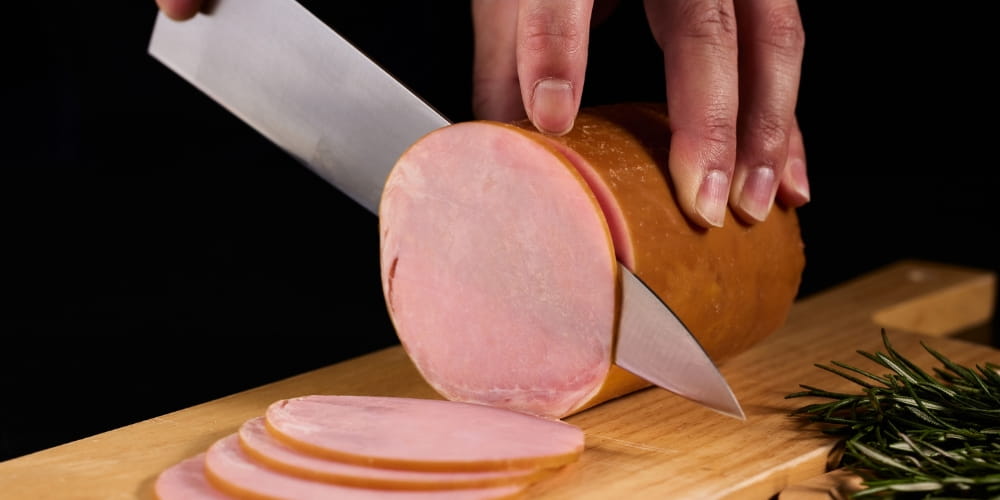
How to carve a whole raw ham
Carving a whole ham (7-9 kg) is an art that reveals its complex aromas – sweet in the maza, salty in the babilla. Precision prevents waste and extends its shelf life (up to 3 months). Essential tools: ham holder, narrow/flexible ham knife (30-35 cm, a smart choice), wide rind knife, and small boning knife. No holder? Wedge it in a rolled-up tea towel or a tilted sink.
Step 1: Prepare your station – safety and stability
Place a stable board on a work surface at elbow height. Wear an apron and protect your hands. Ideal temperature: 18-20°C, away from humidity. Check the ham: taut skin, briny aroma – if it smells of ammonia, discard it.


Position according to your consumption rhythm
- Quick (1-2 weeks): Hoof (narrow part) upwards. Attack the maza (large leg nut, tender and juicy, ideal as an appetizer).
- Slow (1-3 months): Hoof down. Start with the babilla (small nut, drier, keeps better closed).
Secure firmly in the holder – the claw prevents slipping.
Clean without exposing everything (skin removal)
Using a wide blade , score the rind in a crisscross pattern over the 20x20 cm area to be eaten. Carefully remove the rind, along with the outer yellow fat (which is bitter). Leave the white fat in wide strips: it protects the cut from air and prevents drying out. Only remove a maximum of 1/4 of the ham!
Slice thinly and parallel to the bone
Signature technique: Blade flat, parallel to the central bone (visible beneath the pink flesh). Push gently without sawing – the flexible edge glides like butter. Aim for translucent slices (1-2 mm thick, 4-6 cm long, 3-4 cm wide): pink in the center, pearly fat at the edges.
Around the bones: Where's the hip or kneecap? Use a boning knife to trim the meat along the curve, freeing it up for the next slices. Alternate between thin and thicker slices to vary the textures.
Store for optimal freshness
No refrigeration (it kills the flavor)! Cover the cut end with the reserved white fat, press firmly, then with a clean cloth dampened with salt water or cling film. Store away from light, at 15-18°C. One slice per day maximum. If oxidized (brown), trim 1 cm.
Bonus tips:
- Pair with melon, goat cheese or figs.
- No professional tools? Use a DIY ham press or ask the butcher.
Master this, and your ham becomes a gourmet spectacle – tenderness guaranteed!

%20is%20an%20art%20that%20reveals%20its%20complex%20aromas%20%E2%80%93%20sweet%20in%20the%20maza,%20salty%20in%20the%20babilla.%20Precision%20prevents%20waste%20and%20extends%20its%20shelf%20life%20(up%20to%203%20months).%20Essential%20to...)
This site is protected by hCaptcha and the hCaptcha Privacy Policy and Terms of Service apply.