


How to properly sharpen a stainless steel knife
You've probably heard these statements before: "Stainless steel is difficult to sharpen ," "It slips on the whetstone," or "It doesn't hold an edge well." These widespread misconceptions can turn a simple maintenance task into a real source of frustration. However, the reality is much more nuanced.
The secret to success isn't finding a magic technique, but understanding the very nature of the metal you're working with. Indeed, "stainless steel" isn't a single material, but a vast family of alloys with very different properties and behaviors. This article will teach you how to identify the type of stainless steel you have, anticipate its reactions, and finally, choose the right tools to achieve a perfect edge every time.
The myth of the "stainless steel knife": not all stainless steels are created equal
This is the most important point to understand before even taking out your sharpening stone. The performance and feel of sharpening depend directly on the quality and composition of your knife's steel. These can be classified into three main categories.
1. Entry-level stainless steel: soft and tough
- Where to find it: You will find it on supermarket knives, kitchen knives or entry-level knives.
- Characteristics: It is a relatively soft steel, very flexible and extremely resistant to corrosion.
- Sharpening behavior: This type of steel is often responsible for stainless steel's bad reputation. On the whetstone, it can feel somewhat "pasty" or "gummy." Its main characteristic is that it forms a very wide and stubborn burr (the thin metal tip). This burr is so flexible that it is often difficult to remove cleanly, resulting in a mediocre edge even after extensive sharpening.
2. Classic stainless steel for chef's knives: the perfect balance
- Where to find it: It is the steel of most major European cutlery brands (such as Wüsthof, Zwilling, Victorinox) and many quality knives.
- Features: It offers a great balance between good edge retention, high robustness and ease of maintenance.
- Sharpening behavior: This steel is very pleasant to work with. It responds perfectly to most sharpening stones, providing good feedback. It forms a clean, well-defined burr that is easily removed during finishing.
3. High-performance stainless steel: tough and demanding
- Where to find it: It can be found on modern Japanese knives (using steels like VG-10, SG2/R2, etc.) and on knives from high-end specialist brands.
- Characteristics: This is a very hard steel thanks to its high carbon content and the addition of other alloys (vanadium, molybdenum, etc.). It can therefore maintain an exceptional cutting edge for a very long time.
- Sharpening behavior: Its hardness and high wear resistance mean that sharpening can take longer . More passes are needed to remove material. In return, it forms a very fine burr, almost like a micro-lace of metal, which breaks very cleanly at the end. To work it effectively, it requires high-quality stones.


The universal sharpening method (valid for all steels)
Despite these differences in feel and behavior, it's essential to reassure you on one point: the fundamental sharpening process remains exactly the same, regardless of the steel you're working with. The logic doesn't change.
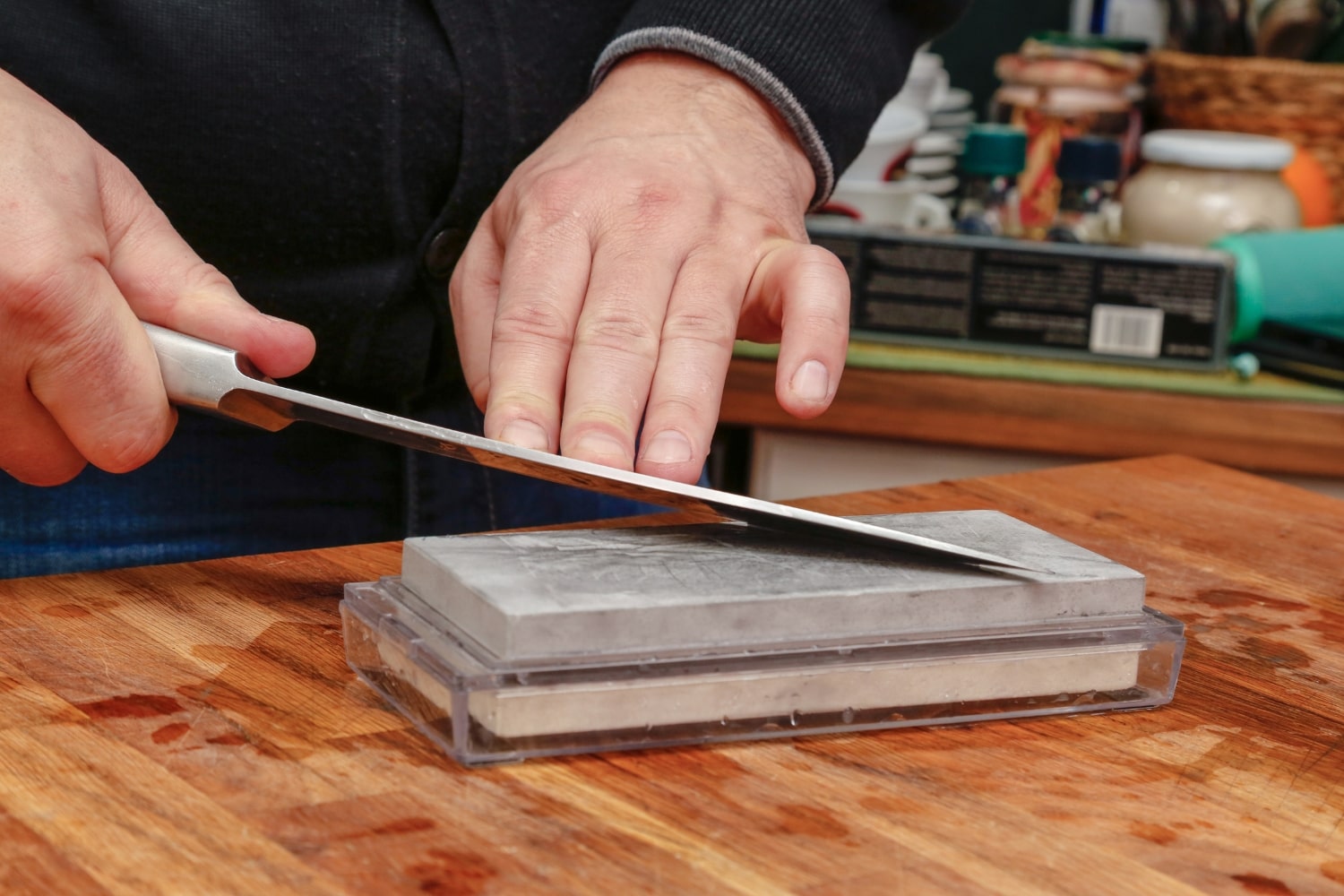
Here is a quick summary of the 5 universal key steps:
- Choosing the angle: For the vast majority of stainless steel chef's knives, an angle between 18° and 22° per side is an excellent starting point.
- Preparing the stone: Make sure your stone is thoroughly soaked (if it is a water stone) and perfectly stable on your work surface.
- Creating the burr: Sharpen the first side of the knife until you can feel a thin burr of metal forming along the entire length of the opposite side. This is your signal of success.
- Symmetry: Turn the knife over and repeat the operation on the second side, until the burr forms in turn.
- The finish: Go over a finer grit stone if you have one, and above all, cleanly and completely remove the burr to reveal the final edge.
Specific tips and tools for stainless steel
Now that the basics are laid, let's see how you can adapt your approach and tools to achieve the best possible results, specifically on stainless steel.
Choosing the right stone: diamond and ceramic, your best allies
Modern stainless steels, especially the hardest ones, contain "carbides," extremely resistant microstructures. To wear them down effectively, an even harder abrasive is needed.
- Why they're effective: Diamond or ceramic abrasives are perfect for this task. They bite into these tough steels with ease, making your sharpening faster and cleaner.
- Our recommendation: If you are investing in a stone specifically for your quality stainless steel knives, a diamond model for the bulk of the work or a ceramic one for the finishing will make a dramatic difference.
Bit management: the key to success on stainless steel
As we have seen, the burr behaves differently depending on the steel. Here's how to manage it:
- For soft stainless steel: The burr is often "gummy" and doesn't want to come off. After your passes on the whetstone, one of the best techniques is to make a few passes on a piece of hardwood (along a cutting board) or on a leather strop. This will cleanly remove this stubborn burr.
- For hard stainless steel: The burr is thin and brittle. Very light, alternating passes over your finishing stone are usually enough to break it cleanly and leave a perfectly clean edge.
Maintaining the cutting edge: the ceramic skewer, a "must-have"
For the daily maintenance of your stainless steel knives (especially the hardest ones), a traditional steel sharpening steel can sometimes prove ineffective. We highly recommend using a ceramic sharpening steel . Being slightly abrasive, it is much better suited to straightening and refreshing the edge of very hard steel.
FAQ: "My stainless steel knife still won't sharpen..."
If, despite all this advice, you are still experiencing difficulties, your problem most likely lies in this section.
-
Problem #1: "The cutting edge seems soft, it bends and doesn't cut cleanly."
- Probable cause: You're working on a low-grade stainless steel and the stubborn burr wasn't removed properly. It folds back and gives that false impression of sharpness.
- Solution: Focus on the final finishing step. Use about ten passes on the corner of your wooden cutting board or on an old leather belt to remove the burr.
-
Problem #2: "I have the impression that the stone doesn't attack the metal; it takes forever."
- Probable cause: You are dealing with a high-performance stainless steel, which is very resistant to abrasion, and your stone is not aggressive enough for it.
- Solution: Patience is your greatest ally. Also, make sure your stone is clean and flat. If the problem persists, investing in a diamond stone (even a small plate) to form the bead will transform your experience.
Conclusion: Understanding your steel is key to sharpening it better.
Ultimately, as you've probably gathered, there's no secret technique or magic method specific to stainless steel. The success of the process depends on your ability to understand the type of steel you're working with.
By understanding its properties, you can adapt your tools, your patience, and above all, your finishing technique to manage the burr. Far from being a difficult or ungrateful metal, stainless steel is a reliable and durable ally in your kitchen. By getting to know it, you'll transform a potentially frustrating task into a mastered, rewarding, and deeply satisfying skill.


This site is protected by hCaptcha and the hCaptcha Privacy Policy and Terms of Service apply.