

How to choose and use a Santoku knife
The Santoku knife, with its wide 16-20 cm blade, excels at slicing vegetables, fish, boneless meat, and chopping herbs. Versatile, quick, and precise, it guarantees a smooth and safe movement, ideal for everyday use in the kitchen.
Wondering how to choose and use a Santoku knife? This Japanese knife with its distinctive design has become a must-have in modern kitchens. Versatile and precise, it offers an effective alternative to the traditional chef's knife .
In this article, you will discover its characteristics, the criteria for selecting the right one, its uses, the cutting techniques to master, and the mistakes to avoid. You will also find a comparison chart and a practical FAQ for further information.
What is a Santoku knife?
Before buying one, understand what distinguishes a Santoku from a classic knife. The Santoku is a Japanese knife with a wide, short blade, generally measuring between 16 and 20 cm. Its name means "three virtues": slicing, chopping, and mincing. Its straight blade with a slightly rounded tip facilitates precise and quick cuts.


The advantages of the Santoku knife
A well-chosen Santoku improves your efficiency and comfort in the kitchen.
- Versatility: ideal for vegetables, fish and boneless meats.
- Precision: thin blade that offers exceptional sharpness.
- Comfort: lighter than a chef's knife, easy to handle.
- Aesthetics: elegant design, often associated with a damask finish.
criteria for making the right choice
Certain technical elements determine the quality and durability of your Santoku.
- Blade length: between 16 and 20 cm, depending on your comfort level.
- Steel: high-end ( Nitrox , VG-10, AUS-8, 58–62 HRC).
- Balance: weight distributed between blade and handle for a fluid movement.
- Handle: in traditional wood ( cherry , pakkawood) or modern composite for ergonomics.
The different types of Santoku knives
Not all Santokus are alike; some have specific variations.
- Classic Santoku: smooth blade, ideal for all uses.
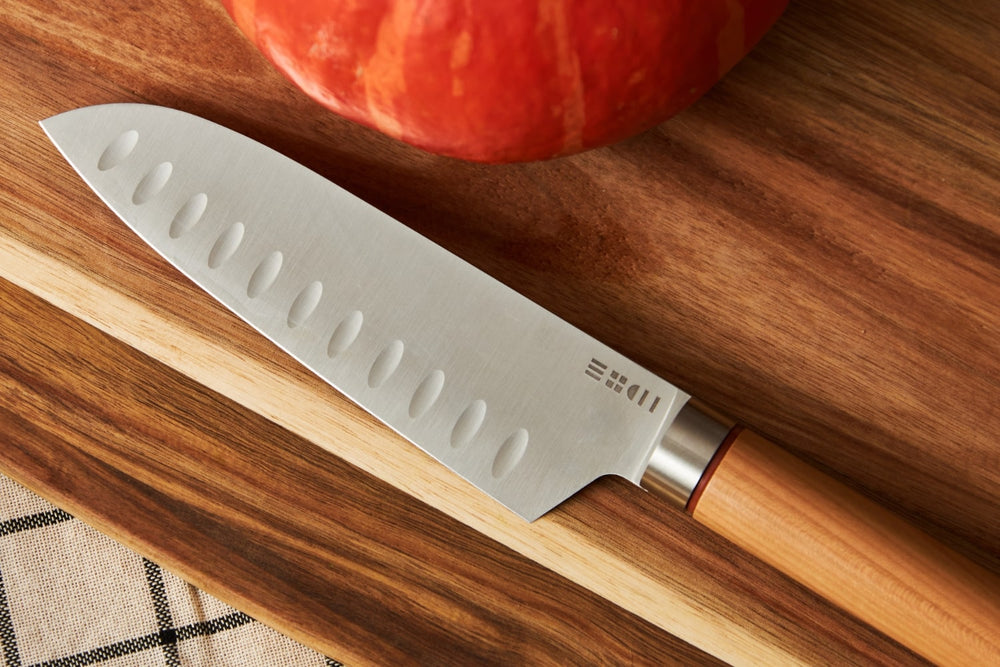
- Santoku with dimples : small dimples on the blade to prevent food from sticking.
- Damascus Santoku: refined aesthetics, superimposed layers of steel for robustness and sharpness.
Comparative table of Santokus
| Kind | Blade length | HRC Hardness | Strengths | Boundaries |
|---|---|---|---|---|
| Classic | 16–20 cm | 58–60 HRC | Versatile, precise | Food sticks |
| Honeycomb | 16–20 cm | 58–61 HRC | Prevents food from sticking | Slightly more fragile |
| Damask | 16–20 cm | 60–62 HRC | Aesthetically pleasing, exceptional cut | Higher price |
How to use a Santoku knife
Mastering the techniques maximizes the potential of this versatile knife.
When to use a Santoku knife
The Santoku is the everyday knife in both Japanese and modern cuisine. Use it to prepare vegetables, fruits, fish, boneless meats, and herbs. However, avoid heavy-duty tasks such as cutting bones or frozen foods, which could damage the thin blade.
Proper handling ensures efficiency and safety
Hold the handle firmly, placing your thumb and forefinger in a pincer grip on either side of the blade, near the guard. Your other three fingers will wrap around the handle. This grip ensures perfect control for effortless cutting.
Cutting techniques with a Santoku knife
- Vertical cutting: straight downward movement, ideal for vegetables.
- Quick chopping: for herbs, garlic, onions.
- Precise slicing: even slices thanks to the wide blade.
- Thinly sliced fish: perfect for sashimi or carpaccio.
Common mistakes to avoid
Improper use reduces the performance of your Santoku.
- Do not cut on hard surfaces such as glass or marble.
- Forcing yourself on frozen or bony foods.
- Neglecting sharpening: a dull blade becomes dangerous.
- Washing in the dishwasher wears down the steel and handle.
How to care for a Santoku knife
Proper maintenance prolongs the life and sharpness of the blade.
- Wash it by hand and dry it immediately.
- Store it in a block or on a magnetic bar.
- Sharpen regularly with a ceramic honing steel.
- Sharpen with the appropriate stone (1000–6000 grit) for a razor-sharp edge.
Ideal recipes with a Santoku knife
Santoku excels in preparations that require consistency and finesse.
- Homemade sushi : clean cut of the fish.
- Raw vegetable salad: quick and even chopping.
- Vegetable wok: efficient and quick chopping.
- Beef carpaccio : perfect cutting edge for thin slices.
Now you know how to choose and use a Santoku knife. Compact, easy to handle, and versatile, it's a major asset for gaining speed and precision. Invest in a model suited to your needs, maintain it carefully, and learn the proper techniques. You'll enjoy a smoother, more enjoyable, and more professional culinary experience.
FAQ
What size blade should I use for a Santoku?
Between 16 and 20 cm, depending on your comfort. To choose and use a Santoku knife properly, adapt the size to your hand.
What HRC hardness rating is recommended for a Santoku?
Between 58 and 62 HRC. This hardness guarantees a durable and precise edge, essential for choosing and using a high-performance Santoku knife.
What is the difference between a Santoku knife and a chef's knife?
The Santoku is shorter and lighter, ideal for vegetables and fish. The chef's knife is longer and more versatile.
How to sharpen a Santoku knife?
Using a suitable sharpening stone, with a grit of 1000 to 6000, allows you to properly maintain and use a Santoku knife.
Can a Santoku replace all knives?
No, it complements it. Ideal for everyday tasks, it does not replace a boning knife or a bread knife.


This site is protected by hCaptcha and the hCaptcha Privacy Policy and Terms of Service apply.