

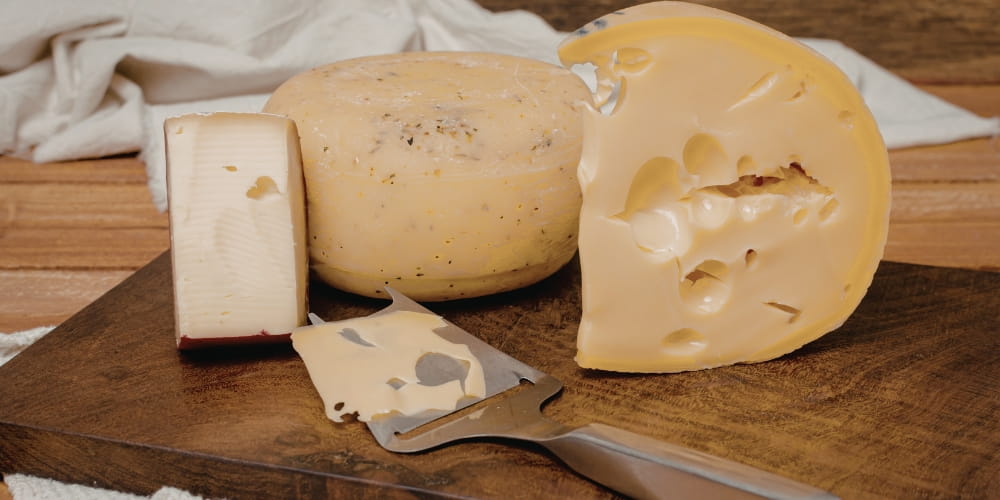
Which knife for which cheese
To cut each cheese properly without damaging it or altering its texture, choose a knife adapted to its paste and rind: this preserves the aromas, avoids sticking and facilitates elegant service on a platter.
Hard cheeses (Comté, Beaufort, Parmesan)
Use a cheese knife (short, almond-shaped blade) or a cheese cleaver (wide, thick blade): the fine point penetrates the rind without chipping it, while the rigidity cleanly slices through old, crumbly cheeses up to three years old. These triangular tools break rather than compress, releasing perfect shards for pure enjoyment. For large wheels of cheese, choose a model with two handles that distributes the effort safely.


Soft cheeses (Brie, Camembert, Saint-Félicien)
Opt for a curved, double-pointed knife (thin and perforated or smooth blade): its rounded shape glides smoothly without sticking to the bloomy rind, and the two prongs are perfect for piercing and placing the piece directly onto the plate. The perforated blade reduces the sticking of the runny cheese, preventing it from deforming or sticking; for spreading, choose a smooth version. This traditional design minimizes contact and preserves the cheese's natural shape.
Blue cheeses with a crumbly texture (Roquefort, Bleu d'Auvergne, Fourme)
Choose a cheese wire (thin, sharp wire) or a cheese knife (long, pointed, curved blade): the wire cuts precise slices without crumbling the moist cheese, while the curved blade scrapes the blue veins without crushing them. The cheese wire excels at creating thin, even slices, ideal for creamy cheeses that melt quickly at room temperature. Avoid straight blades, which can damage marble surfaces.
Semi-hard or soft cheeses (Mozzarella, Fresh goat cheese, Saint-Nectaire)
Choose a serrated knife or a cheese slicer for moist cheeses: the serrations grip without tearing, and the edge ensures even slices that melt beautifully in raclette or salads. For small portions like burrata, a miniature cheese knife (a smaller version of the curved one) is sufficient, with its convenient double tip for serving. These tools maintain the cheese's elasticity without excessive compression.
General tips
Clean and change your knife between each cheese to avoid flavor mixing, and place them on a stable wooden board; sharpen them regularly because a dull tool compresses instead of slicing. A set of 4-6 specialized knives (chisel, lyre, curved, cleaver) covers all French cheese boards, transforming tasting into a precise art that respects the terroir.


This site is protected by hCaptcha and the hCaptcha Privacy Policy and Terms of Service apply.