

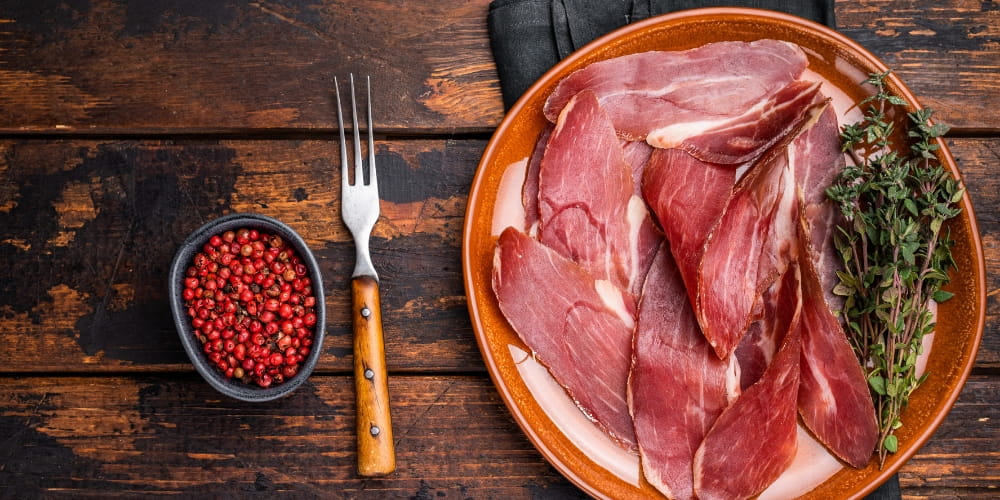
What knife should I use to cut prosciutto
To cut a raw ham (such as Bayonne, Parma, Serrano or Iberian ham) into thin and regular slices without tearing the delicate flesh or risking injury, the choice of knife is crucial: it must combine thinness, length and flexibility to follow the curves of the piece.
Main knife: the ham knife
Choose a cured ham knife with a long (25-35 cm), thin (1.5-2 mm thick), and flexible blade made of high-grade stainless steel. This flexibility allows you to adapt the cut to the irregular contours of the ham, producing translucent 1-2 mm slices ideal for optimal enjoyment. The dimples on the blade (small grooves) create air pockets that prevent fat from sticking, facilitating a perfect glide even on a heavily marbled ham. Brands like Arcos, Victorinox, and Sabatier excel in their long-lasting sharpness. Sharpen it with a honing steel before each use for surgical precision that preserves the aromas and textures.


Additional knives for preparation
Use a boning knife (short, pointed blade, 12-15 cm) to remove the rind, oxidized fat, and parts near the bone: its thinness reaches delicate areas without wasting meat. A chef's knife (20-25 cm, wide, rigid blade) complements this for the initial cut and trimming of impurities, applying controlled force without damaging the surface. These tools form an essential trio for professional butchering, from cleaning to the final slice.
Appropriate technique and support
Secure the ham to a stable ham holder (with clips), lean side up, and begin by slicing parallel to the bone, angling the blade at 30° for melt-in-your-mouth pieces. Aim for a consistent thickness for even maturation. Work at room temperature (18-20°C) for a clean cut, and alternate thin slices of duck breast (the prime cut) with thicker slices of rind for added variety. A dull knife compresses the meat, compromising its tenderness; maintain it for professional results.
Additional tips
For beginners, a dimpled blade is more forgiving of minor angle errors; clean it with hot water without soaking to prevent corrosion. Pair it with a pocket knife to trim the edge between hams. With this tool, your carving will reveal the full richness of cured ham, a staple of French and Iberian appetizers.


%20into%20thin%20and%20regular%20slices%20without%20tearing%20the%20delicate%20flesh%20or%20risking%20injury,%20the%20choice%20of%20knife%20is%20crucial:%20it%20must%20combine...)
This site is protected by hCaptcha and the hCaptcha Privacy Policy and Terms of Service apply.