

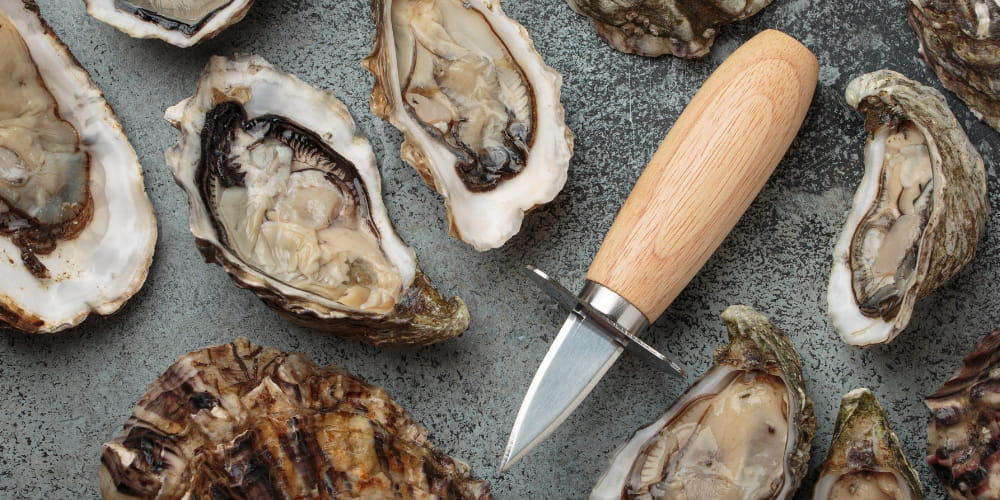
What is the best knife for opening oysters?
The best knife for opening oysters is an oyster knife (or a specialized knife called an "oyster knife"), designed to insert its fine point between the shells and slice through the adductor muscle without damaging the flesh or risking injury. Unlike an ordinary kitchen knife , it combines rigidity, a short blade (6-8 cm), and ergonomics for precise and safe opening, even for the tightest oysters. These professional models prevent dangerous twisting and are often made of stainless steel to withstand seawater.
Essential characteristics
Choose a short (6-8 cm), rigid blade with a pointed end, either single or double-edged for left- or right-handed use, to pierce the hinge without excessive force. The handle should be ergonomic, non-slip (made of exotic wood like rosewood, resin, or sheathed stainless steel), thick enough for a firm grip even with gloves, and 15-18 cm long overall for good leverage. High-end materials like Nitrum or Sandvik steel ensure durability and corrosion resistance, while a protective sheath is a plus for maintenance .


Recommended models
Among the most popular models for 2025-2026, the La Bonne Graine oyster knife (stainless steel and rosewood, ~16 cm) excels in its finesse and robustness, ideal for professional oyster shuckers or experienced amateurs. The Westmark stands out with its wide, double-edged blade for effortless opening, versatile for mussels. The Arcos Nitrum offers surgical precision thanks to its patented technology, perfect for intensive use in restaurants. These choices surpass basic models with their proven reliability.
Technology and safety
To open an oyster, place it on a folded cloth (hollow side up), insert the tip near the hinge, twist to cut the upper muscle, then the lower muscle by sliding it under the flesh – never flat to avoid splintering. Always wear a thick glove on the hand holding the oyster and aim for fresh oysters (tight shell, heavy with water). A good knife reduces the risk by 90% compared to an unsuitable tool, but practice is just as important as the tool.
Maintenance and purchase
Clean with fresh water, dry immediately, and lightly oil the blade to prevent rust; sharpen it on a whetstone every 10-20 uses. Buy from specialists (specialized cutlery shops) for €20-50, avoiding supermarkets where flexible blades break easily. French artisans (Thiers) offer the best value for money and durability for regular use.


,%20designed%20to%20insert%20its%20fine%20point%20between%20the%20shells%20and%20slice%20through%20the%20adductor%20muscle%20...)
This site is protected by hCaptcha and the hCaptcha Privacy Policy and Terms of Service apply.