

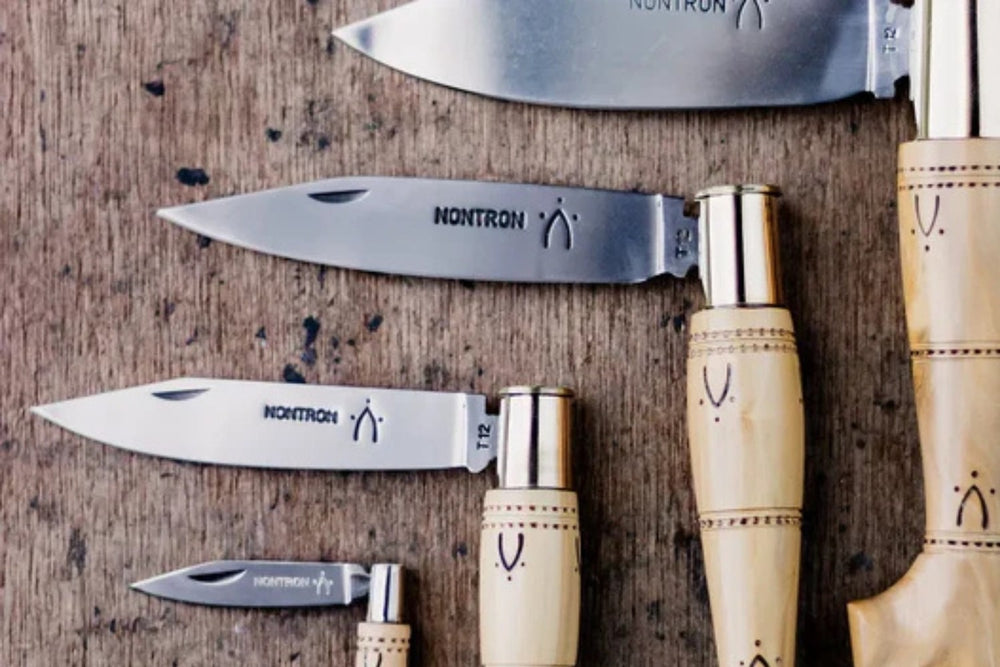
The history of the Nontron knife and its craftsmanship
The story of the Nontron knife and its craftsmanship is that of an object that transcends time without losing its soul. Born in the small village of Nontron, in the heart of the Périgord region, this pocket knife is considered the oldest folding knife in France. For centuries, it has embodied the marriage of utility and elegance, manual skill and local culture.
Here you will discover how this knife became an icon, what stages mark its manufacture, why its distinctive features still fascinate and how its craftsmanship continues to shine today.
The medieval origins of the Nontron knife
The Nontron knife has its roots in the Middle Ages. Records from the 15th century mention the production of tools and blades in this region of the Périgord Vert. However, some historians believe that the first knives appeared much earlier, perhaps as early as the Carolingian era.
Nontron, a small hilltop town in the north of the Dordogne, already had a strong metalworking tradition. Craftsmen forged edged weapons, nails, and agricultural tools. It is in this context that this very particular folding knife appeared, distinguished by its refined simplicity.


A knife linked to rural daily life
The history of the Nontron knife and its craftsmanship is closely linked to peasant life. This robust and versatile knife accompanied men and women in all their tasks. Peeling fruit, cutting rope, whittling wood, or dividing bread: it was used for everything.
This connection to rural life explains why the Nontron knife has remained popular throughout the centuries. Unlike luxury knives reserved for an elite, the Nontron has always retained its practical function. It was a faithful everyday tool, passed down from generation to generation.
The unique characteristics of the Nontron knife
A Nontron knife is recognizable at first glance. Its identity rests on three main elements:
- The boxwood handle : turned by hand, it retains its blond color and develops a beautiful patina over time.
- Pyrography: traditional motifs engraved with fire, often in the shape of crosses, stars or dots. These decorative symbols also had symbolic and protective value.
- The thin, pointed blade: ideal for precise cuts, formerly forged from carbon steel and now often from stainless steel.
Every detail reflects a balance between simplicity and refinement. The Nontron does not seek to shine through ostentation but through understated elegance.
The handcrafted production of a Nontron
Crafting a Nontron knife is an art that demands patience and precision. Each step is carried out by hand by artisans trained in this centuries-old craft.
- Choice of wood: boxwood is selected for its density and fine grain.
- Turning the handle: the wood is shaped on a lathe to obtain a harmonious silhouette.
- Pyrography: traditional designs are marked with a hot iron, a precise and delicate gesture.
- Blade forging: the steel is cut, polished and sharpened according to precise techniques.
- Assembly: blade and handle are assembled by hand, guaranteeing strength and smooth folding.
- Finishing touches: polishing, quality control, adjustments.
This process combines ancient techniques and modern tools, but the essence remains the same: a knife made to last.
A tradition preserved and modernized
The history of Nontron knives and their craftsmanship could have ended with industrialization. Yet, cutlery has evolved. Even today, in the Nontron workshop, artisans perpetuate the tradition while adapting certain aspects to modern needs.
The models have diversified: table knives, kitchen knives , sommelier knives… but all retain the DNA of Nontron: boxwood handle and emblematic pyrography.
This blend of tradition and innovation allows the Nontron brand to remain alive and recognized throughout the world.
The Nontron compared to other regional knives
France is full of iconic regional knives: the Opinel from Savoy, the Laguiole from Aveyron, the Thiers from Auvergne. Each has its own identity, history, and clientele. But the Nontron retains a special prestige, linked to its antiquity and minimalist style.
Here is a comparative table to better situate Nontron within this rich tradition:
| Knife | Origin | Handle feature | Decorations | Date of appearance |
|---|---|---|---|---|
| Nontron | Périgord | Turned boxwood | Pyrography | 15th century |
| Laguiole | Aveyron | Horn, various woods | Carved bee | 19th century |
| Opinel | Savoy | Simple wood | Safety ring | 19th century |
| Thiers | Auvergne | Varied | Engraved logo | 20th century |
The Nontron is distinguished by its age, its simplicity and its traditional fire ornamentation.
An object for collection and transmission
From a simple rural tool, the Nontron has become a collector's item. Each one is unique, marked by the craftsman's hand and the singularity of the wood chosen. Some antique models are passed down as family heirlooms.
Owning a Nontron is owning a piece of history. It is also participating in the preservation of a rare craft, at a time when industry standardizes objects.
The future of the Nontron knife
Today, the future of Nontron is being built on a foundation of tradition and openness to the world. Cutlery production continues in the Dordogne, training new artisans. Food lovers, collectors, and heritage enthusiasts are rediscovering its timeless charm.
The history of the Nontron knife and its craftsmanship is therefore not static. It reinvents itself with each generation, in the hands of those who make them as well as in the hands of those who use them.
Conclusion: a skill to be kept alive
The story of the Nontron knife and its craftsmanship is the story of a humble object that became an icon. From the Middle Ages to the present day, it has traversed the centuries without losing its identity: boxwood handle, protective pyrography, discreet elegance.
If you're looking for a knife that tells a story, that connects everyday use to the memory of a region, the Nontron is a unique choice. By choosing it, you're not just owning a tool: you're becoming a guardian of a craft.
Frequently Asked Questions about the Nontron Knife
What is the origin of the Nontron knife?
The Nontron knife comes from Périgord, in the Dordogne. Its craftsmanship is mentioned as early as the 15th century, and it is considered the oldest French knife.
How to recognize a Nontron knife
You can spot it by its turned boxwood handle, adorned with geometric pyrography. Its thin, pointed blade completes its discreet and refined style.
Is the Nontron knife still made by hand?
Yes, each Nontron knife is handcrafted in the Nontron workshop, where artisans perpetuate a centuries-old and meticulous know-how.
What is the difference between Nontron and Laguiole?
The older Nontron knife is distinguished by its pyrography-decorated boxwood handle. The Laguiole knife, which originated in the 19th century, is recognizable by its sculpted bee.
Why choose a Nontron knife today?
Choosing a Nontron knife means acquiring a useful and elegant object, but also preserving a unique craftsmanship and supporting an authentic French tradition.


This site is protected by hCaptcha and the hCaptcha Privacy Policy and Terms of Service apply.