

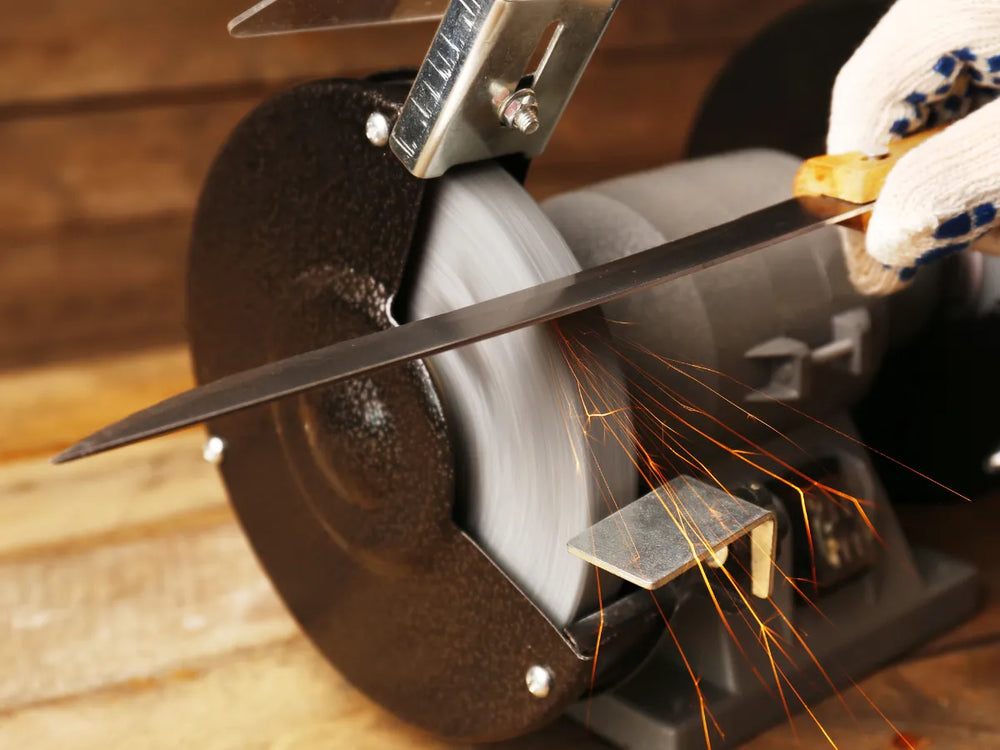
What angle should you choose to sharpen your knife?
You can own the best sharpening stone in the world, but without mastering one key element, your efforts will be in vain. That secret ingredient is the sharpening angle. It may seem like a complex concept, a specialist's domain reserved for professionals, but it's actually much simpler than it appears.
What is the sharpening angle and why is it so important?
Before choosing a sharpening angle, it's essential to understand what it is and its direct impact on your knife's performance. It's essentially the DNA of your blade's edge, its fundamental geometry.
Simple definition: angle per side and total angle
When we talk about the sharpening angle, we're generally referring to the angle formed between the blade and the surface of your sharpening stone, and this applies to one side only . It's important to note that the final edge of your knife has a total angle (also called the inclusive angle) which is simply double this value.
For example, if you sharpen your knife at a 20° angle on each side, the edge of your blade will have a total angle of 40°.
The fundamental compromise: sleekness versus durability
The choice of angle relies on a simple balance, a constant compromise between the precision of the cut and the durability of the edge. To better visualize this, imagine the difference between an axe and a surgeon's scalpel.
- A shallow angle (e.g., 15°) : This creates an extremely thin wire, almost as sharp as a razor. This angle is perfect for surgically precise cuts. However, such a thin wire is mechanically more fragile and will wear out or be damaged more quickly.
- A high angle (e.g., 22°) : This creates a wider edge, making it much stronger and more durable. This cutting edge will better withstand tough tasks and impacts. However, it will offer a less aggressive "bite" than a thinner edge.
In conclusion, you understand that there is no single "best" angle. It's a strategic choice you must make based on the type of knife you have, the hardness of its steel, and, above all, how you intend to use it.


The guide to recommended angles by knife type
To help you make this strategic choice, here are some concrete guidelines and recommended angle values for the most common types of knives. This will allow you to easily find the ideal configuration for your equipment.
1. European kitchen knives (chef's, paring, etc.)
- Typical angle: 18° to 22° per side.
- Explanation: These knives are the workhorses of the kitchen. They are designed to be versatile and robust, capable of slicing a wide variety of foods, from delicate herbs to the toughest root vegetables. This angle gives them an excellent balance between a sharp edge and great durability.
2. Japanese kitchen knives (santoku, gyuto, nakiri)
- Typical angle: 12° to 17° per side.
- Explanation: Japanese knives are often made with very hard steels and are specialized in fine, precise cutting. A shallower angle allows them to fully exploit the quality of their steel to achieve a remarkably effective edge.
3. Specialty knives (net, outdoor, pocket)
- Fillet knives: They benefit from a very small angle (12-15°) which maximizes their cutting capacity and flexibility to follow the fish bones.
- Pocket or hunting knives: Here, strength is prioritized with a higher angle (22-25°), which guarantees a cutting edge resistant to difficult tasks in the field.
Summary table of sharpening angles
For quick reference, here is a summary table that you can consult at any time.
| Knife Type | Angle by Side | Total Angle | Sharpness Characteristics |
| Japanese (Santoku, etc.) | 12° – 17° | 24° – 34° | Extreme finesse, surgical precision |
| European (Chief, etc.) | 18° – 22° | 36° – 44° | Versatility, good balance of sharpness and durability |
| Fillet knife | 12° – 15° | 24° – 30° | Very thin, flexible |
| Pocket/hunting knife | 22° – 25° | 44° – 50° | Very robust, shock resistant |
How to find and maintain the perfect angle: tips and tools
Knowing which angle to choose is one thing, but maintaining it consistently throughout the sharpening process is another. This is undoubtedly the biggest challenge for beginners. Fortunately, several solutions exist to help you.
The visual method: the coin trick
This is a very simple trick to train your eye and hand. By placing one or more coins under the back of your knife resting on the stone, you can easily visualize the angle to maintain.
- 1 piece (≈ 1.5 mm): corresponds to a very small angle, for a Japanese knife.
- 2 pieces (≈ 3-4 mm): corresponds to an average angle of 20°, perfect for a chef's knife.
The verification method: the marker technique
This technique is foolproof for knowing if you are holding the correct angle.
- Color the entire surface of the bevel of your knife (the small already angled part that forms the edge) with a permanent marker.
- Make one or two passes on your sharpening stone.
- Observe where the ink has disappeared:
- The ink has spread across the entire surface of the bevel: Congratulations, your angle is perfect!
- The ink has only come off on the top of the bevel (away from the edge): Your angle is too shallow, you need to raise the back of the knife a little.
- The ink has only come off on the edge of the blade: Your angle is too high, you need to lower the back of the knife a little.
The easy solution: angle guides
To make things easier, especially at the beginning, there are some very handy tools available. Angle guides are small accessories that clip directly onto the back of the knife to ensure the correct angle. There are also more comprehensive guided sharpening systems (like Lansky, Work Sharp, etc.) that lock both the knife and the sharpening stone in place for absolute control of the angle.
What if you don't know the original angle of your knife?
Do you have a knife but don't know its brand or factory angle? Don't panic. Here's a simple method to find out for yourself and respect the manufacturer's intentions.
You can use the "backwards" marker technique for this:
- Color the bevel of your blade.
- Start with an angle that you think is too shallow (e.g., 10°). Make a very light pass. The ink should only come off at the top of the bevel.
- Raise the angle very gradually, pass after pass, until you find the exact point where the ink disappears along the entire height of the bevel, from the top to the edge.
- You have found the original angle of your knife!
In case of absolute doubt, and if it is a standard kitchen knife, choosing an angle of 20° per side is always a safe, versatile and effective choice.
Conclusion: Consistency is more important than perfection
You now have all the information you need to choose and apply the correct sharpening angle. You understand that it's a compromise between finesse and robustness, and that this choice depends primarily on your knife and how you intend to use it.
Remember one last thing, the most important of all: maintaining a consistent angle throughout your movement is far more crucial than striving for absolute precision. A steady 19° sharpening will always be better than a hesitant one that fluctuates between 15° and 22°. Trust your muscle memory, which will develop with practice. Give it a try, and you'll be amazed by the results.


This site is protected by hCaptcha and the hCaptcha Privacy Policy and Terms of Service apply.