


Knife sharpening angle chart
Knife sharpening angles vary depending on the type, origin (Western or Japanese), and intended use, as too sharp an angle makes the blade brittle while too wide an angle quickly dulls the edge. This table summarizes standard recommendations per side of the blade (doubled for the overall angle), based on European and Japanese artisanal practices to optimize performance and durability.
Table of recommended sharpening angles
| Knife type | Angle by side | Total angle | Main notes |
|---|---|---|---|
| Western cuisine (chef) | 20°-22° | 40°-44° | Balance of sharpness/durability for chopping hard meats and vegetables. |
| Japanese cuisine (gyuto, santoku) | 15°-17° | 30°-34° | Fine cutting edge for precise cuts; ideal for SG2 or VG10. |
| Peeling/Preparing | 15°-18° | 30°-36° | Precision on fruits/vegetables; Nitrox or X50 perfect. |
| Butcher/Meat Cutter | 20°-22° | 40°-44° | Robustness for soft bones; reinforced stainless steel recommended. |
| Scalloped bread | 20°-22° | 40°-44° | Conical sharpening in the grooves only. |
| Fish filleting | 15°-18° | 30°-36° | Flexible blade for fine contours. |
| Nakiri (Japanese vegetables) | 15°-17° | 30°-34° | Clean vertical cut on roots/grass. |
| Sashimi/sushi | 12°-15° | 24°-30° | Ultra-sharp for raw fish slices; carbon steel or VG10. |
| Hunting/outdoor | 22°-25° | 44°-50° | Resistance to hard materials such as cartilage or rope. |
| Pocket/EDC | 20°-25° | 40°-50° | Versatile for everyday use; easy maintenance with Nitrox. |


Factors influencing the choice of angle
A hard steel like SG2 (62+ HRC) tolerates shallower angles (12°-15°) for a razor-sharp edge that lasts for weeks, but is prone to chipping on hard materials; conversely, a softer X50CrMoV15 (55-57 HRC) prefers 20°+ to avoid deformation during rough family use. Japanese single-sided blades (kataba) concentrate the angle on one side only (15° on the cutting edge, flat on the other), while European blades are symmetrical for bidirectional strength. Adjust the angle according to the steel: Nitrox (56-60 HRC) excels at 16°-18° for its corrosion resistance combined with good durability.
Techniques for maintaining the precise angle
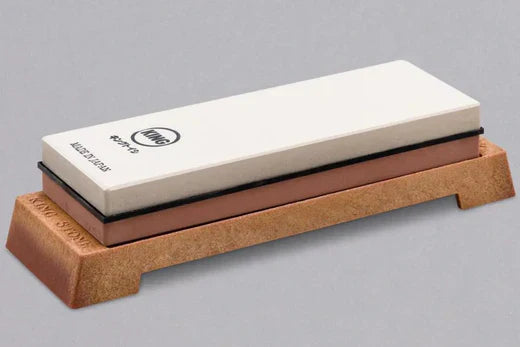
Use an angle guide or a marker (pencil on the blade) to visualize even abrasion during the first few passes on the whetstone (1000 grit for shaping, 3000+ for polishing). For beginners, fixed-angle sharpeners (15°/20°) simplify the process without risking altering the original geometry, especially on cherry wood handles which require a stable grip. Test the sharpening on paper or a tomato: a correct angle should allow the blade to glide smoothly without tearing, prolonging the life of the Damascus or Nitrox steel blade.

,%20and%20intended%20use,%20as%20too%20sharp%20an%20angle%20makes%20the%20blade%20brittle%20while%20too%20wide%20an%20angle%20quickly%20dulls%20the%20edge.%20Thi...)
un grand merci pour un novice en la matière
laurent
This site is protected by hCaptcha and the hCaptcha Privacy Policy and Terms of Service apply.