

Japanese vs. French knife: 5 main differences
Japanese and French knives are distinguished by their design, adapted to different culinary traditions: precision and finesse for the Japanese, robustness and versatility for the French.
Steel and hardness
Japanese knives often use high-carbon steels, such as VG10 or Shirogami, achieving a hardness of 58 to 66 HRC on the Rockwell scale. This gives them an exceptionally sharp and long-lasting edge, but makes them more fragile and susceptible to damage. Conversely,French knives are generally made of stainless steel with a hardness of around 55 HRC, which is more flexible and durable, although it dulls more quickly and requires frequent sharpening. This difference stems from forging techniques: the Japanese favor hand-forging for an ultra-hard blade, while the French opt for industrial stamping, which prioritizes strength.


Sharpening angle
The Japanese knife has a shallow sharpening angle , around 15 degrees per side, allowing for a surgical cut ideal for vegetables or fish. French knives have a wider angle, from 17 to 20 degrees, which increases their resistance to impacts during rougher cuts. This narrow Japanese angle requires precise sharpening on a whetstone (1000-6000 grit), while French knives can be sharpened with a honing steel or a basic stone. Understanding this helps you choose according to your needs: meticulous precision or heavy-duty use.
Blade Thickness and Shape
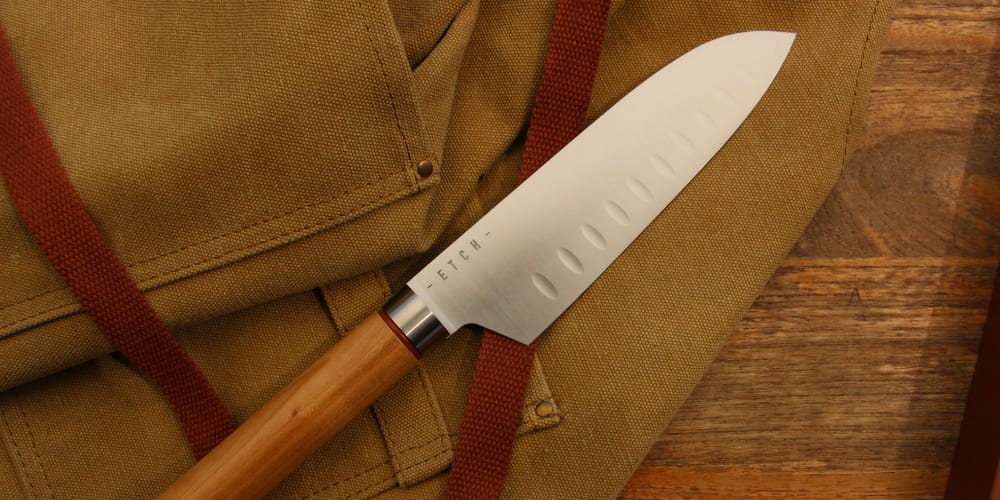
Japanese blades are thin, facilitating a smooth cut without resistance, but are prone to breakage on bones or hard foods. French blades, thicker in shape, can withstand back-and-forth movements and greater force, making them well-suited for cutting meat. In terms of shape, the Japanese Santoku has a straight blade with a slight curve for quick chopping; the French chef's knife has a pronounced curve for a more fluid, swinging motion. The Japanese drop-point knife offers better balance for precision. These characteristics reflect the different cuisines: delicate sashimi versus hearty stews.
| Criteria | Japanese Knife | French Knife |
|---|---|---|
| Blade thickness | Fine (fluidity) | Thick (strength) |
| Typical shape | Straight, drooping point | Bent, point raised |
| Main use | Precision (vegetables, fish) | Versatile (meat, mincing) |
Handle and weight
Japanese handles, made of wood such as magnolia, have an ergonomic "D" shape for a right-handed grip and are lightweight for quick, fatigue-free movements. French handles, made of riveted wood or polymer, are heavier and balanced for power. The Japanese weight promotes agility in Asian cuisine; the French, strength in Western cooking.
Use and maintenance
Specialized Japanese knives, like Nakiri (vegetables) or Yanagiba (fish), excel at specific tasks. French knives, on the other hand, are versatile and can handle anything. The Japanese ritual of honing (using a water stone) prolongs the edge; French knives are more forgiving but less durable. For a beginner, a French knife is more forgiving; a passionate enthusiast will choose a Japanese knife for its superior precision. These contrasts highlight different philosophies: dedicated excellence versus a universal tool.


This site is protected by hCaptcha and the hCaptcha Privacy Policy and Terms of Service apply.