

5 Key Criteria for Choosing a Good Kitchen Knife
Choosing the perfect kitchen knife in 2026 hinges on a precise balance between performance, comfort, and durability, because an ill-suited tool tires the hand and quickly dulls with daily use. These five key criteria, validated by professionals from Thiers to Solingen, transform your cutting into fluid precision, whether you opt for a stainless Nitrox knife or a Japanese SG2.
Blade steel quality and type
The steel determines the longevity of the cutting edge: aim for a hardness of 56-62 HRC for optimal durability without excessive fragility, such as X50CrMoV15 (56 HRC, versatile stainless steel) or Nitrox (58 HRC, superior corrosion resistance thanks to nitrogen). SG2/VG10 powders (62 HRC) excel in fineness for gyuto, but require technical sharpening; carbon steels (1095, 60+ HRC) cut razor-sharp but rust without immediate drying. Choose forged (solid, robust) over stamped (lightweight, affordable), as forging homogenizes the grain to withstand impacts on hard vegetables or meats.


Specific use and blade shape
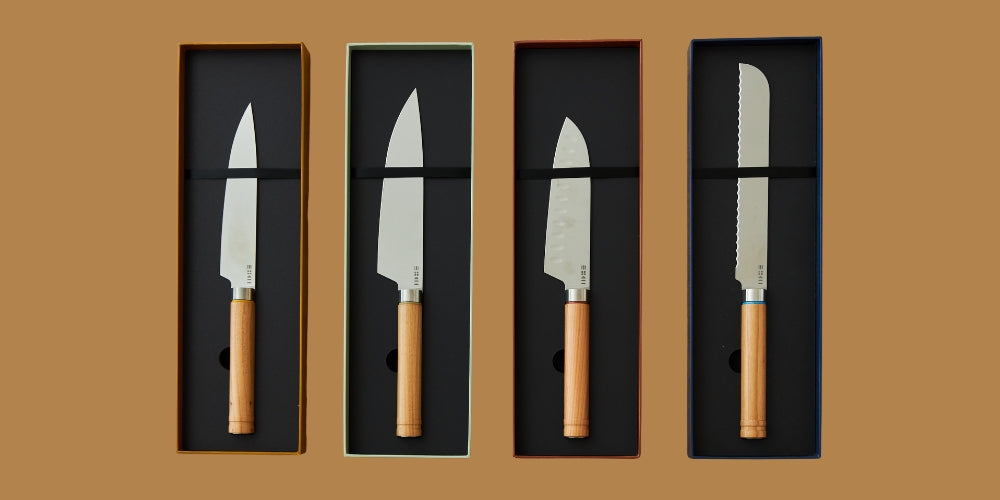
Adapt to your routine: a versatile chef's knife (18-22 cm, straight or curved blade) slices onions/meat with a rocking motion; a paring knife (8-12 cm, fine point) peels fruit precisely; a serrated bread knife (20-25 cm, saw-like) slices crusts without crushing the crumb. A Japanese knife (single blade, 15° angle per side) is ideal for fine push-cuts, while a symmetrical European knife (20° angle) offers robustness. Test the geometry: a thin blade (2-3 mm thick) glides more easily, a thicker one is more resistant to bone; Nitrox or genuine Damascus steel creates the wavy patterns visible on the slice.
Ergonomics and handle material
A poorly designed handle can cause tendonitis: opt for an ergonomic handle (Japanese octagonal or Western bulbous) made of micarta/G10 (non-slip, hygienic), stabilized cherry wood (warm, fine grain, 650 kg/m³), or synthetic POM for wet grips. Triple stainless steel riveting ensures strength; a total weight of 100-150g prevents wrist twisting. For professionals, color-coded handles (Swibo yellow) prevent confusion; test the grip for 5 minutes: it should fit snugly in the palm without any greasy slippage.
Balance and overall weight
The pivotal balance (blade/handle) dictates fluidity: consider the weight of the bolster (handle-blade reinforcement); a light Japanese bolster (90g Global) reduces fatigue when using precision, while a heavy Wüsthof (150g) excels at powerful chopping. Check for a full tang extending through the handle for stability; a front imbalance causes bouncing on the board, while a rear imbalance causes arm fatigue. Ideally, the center of gravity should be 2-3 cm from the reinforcement, extending sessions without cramps.
Maintenance and ease of use
Nitrox/X50 stainless steel is easy to clean (hand, warm sponge), dries instantly for corrosion protection; carbon steel is oiled regularly. Simple sharpening (15-20° angle on a 1000/3000 grit stone) is a bonus: Nitrox sharpens quickly without expertise. Lifetime warranty (Victorinox) and traceability (Thiers hallmark) ensure after-sales service; avoid using a dishwasher, which can cause wood to swell. Start with a basic set (20 cm Nitrox cherry wood chef's knife, paring knife, serrated bread knife) covering 90% of your needs.
Comparative table of criteria
| Criteria | Ideal recommendation | Examples of steel/handles | Key advantage |
|---|---|---|---|
| Steel | HRC 56-62, stainless steel Nitrox/SG2 | Nitrox, VG10, X50 | Sharp outfit |
| Use | 20cm versatile chef | Gyuto, office 10 cm | Appropriate precision |
| Sleeve | Ergonomic micarta/cherry wood | POM anti-slip | Extended comfort |
| Balance | Pivot mitre, 120g | Full riveted tang | Fluidity of movements |
| Interview | Hand wash, sharpen at 15-20°C | Rust-free stainless steel | Daily sustainability |
Master these criteria and your knife becomes an extension of your hand: test in store, prioritize Nitrox for perfect balance in 2026.



This site is protected by hCaptcha and the hCaptcha Privacy Policy and Terms of Service apply.