

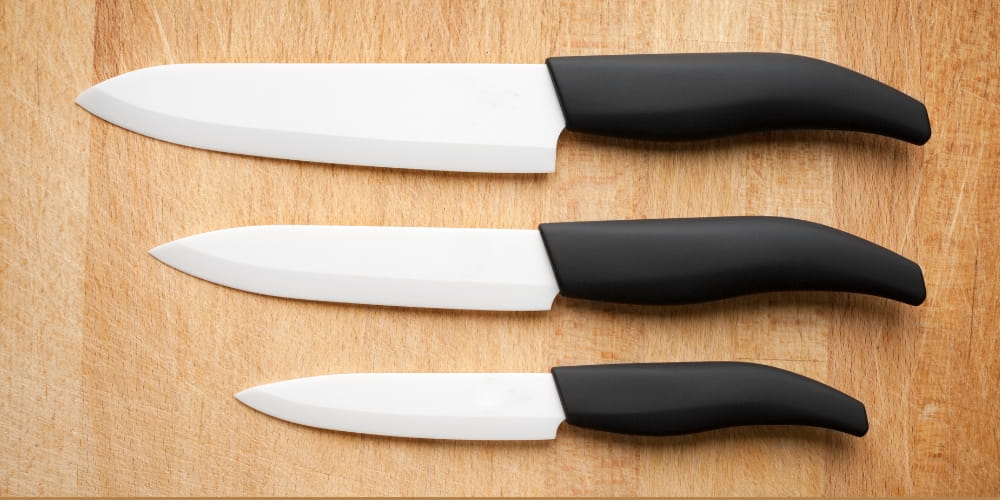
How to properly sharpen a ceramic knife
To sharpen a ceramic knife without risk of breaking it, follow techniques adapted to its exceptional hardness ( 9/10 on the Mohs scale ), which resists acidic foods but requires specific abrasive tools and great delicacy.
Essential tools
Use only diamond sharpeners or stones, as only diamond (10/10 hardness) can machine the zirconia of the blade without damaging it. A manual diamond sharpener with two grooves (fine/coarse grit) is ideal for beginners: it automatically guides the angle to 15-20° and restores the edge in 5-10 strokes per side. Flat diamond stones (600-1200 grit) offer greater precision for professional sharpening; lightly wet them to remove debris. Absolutely avoid steel honing tools, traditional stones , or grinding wheels, which either slip ineffectively or scratch the blade.


Step-by-step technique
Work on a stable surface at a constant 15° angle (like holding a euro note against the blade for visualization). Soak the tool for 5 minutes, then run the blade slowly (10-15 times per side) without applying pressure: the diamond cuts through the material with gentle friction, not force. Test the edge on paper or a tomato – it should cut cleanly without tearing. Finish with 5 passes on a fine grit sandpaper to polish, and buff with an oiled leather strop for a razor-sharp edge. Have it professionally re-sharpened by the manufacturer (Kyocera, Global) every 5-7 years if it becomes dull.
Essential precautions
Ceramics are sensitive to impacts: avoid pressure, sudden movements, or storing them in contact with metal, as this can lead to invisible micro-cracks that can spread. Wash in lukewarm water without prolonged soaking, and dry immediately. These blades retain their edge 10 times longer than steel, but improper sharpening will ruin them permanently. For daily maintenance , a simple honing on a ceramic sharpener with a wheel is sufficient without removing any material.
Frequency and alternatives
Sharpen only if the knife slips on hard vegetables: every 3-5 years for home use. If your knife is fragile or expensive, opt for professional sharpening. This approach will restore your ceramic blade to a surgical cut, ideal for fish, herbs, or delicate meats without oxidation or altered taste.

,%20which%20resists%20acidic%20foods%20but%20requires%20specific%20abrasive%20...)
This site is protected by hCaptcha and the hCaptcha Privacy Policy and Terms of Service apply.