

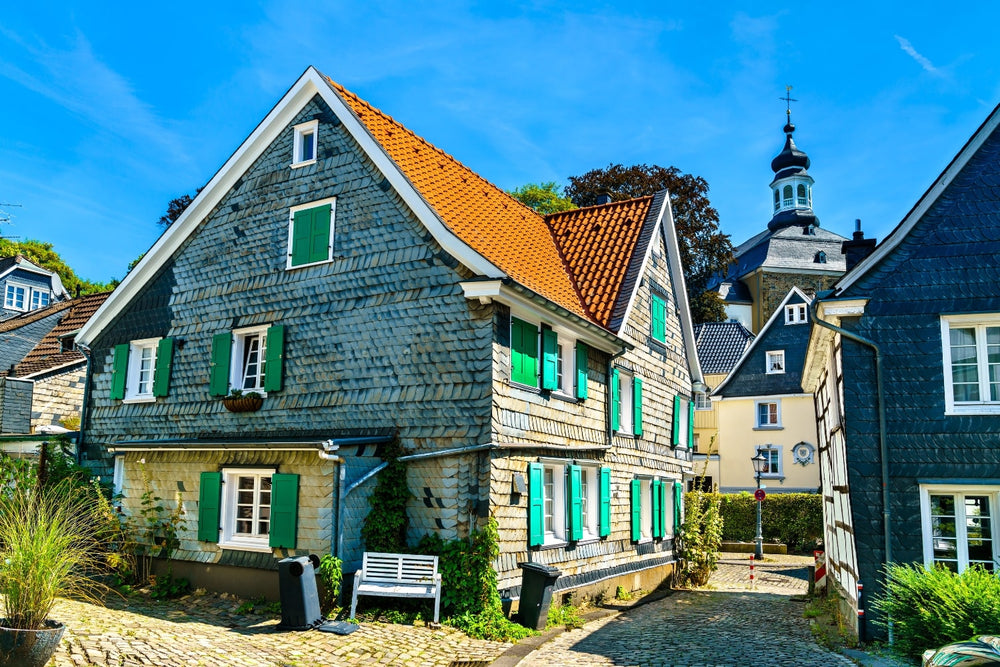
Solingen: history of the capital of German cutlery
For knife, razor, and scissor connoisseurs worldwide, the word "Solingen" evokes far more than just a German city. It's a label, a true seal of quality, recognized and respected for centuries. It's the promise of a sharp, reliable, and durable tool, crafted according to the highest standards.
But how did a medium-sized city, nestled in North Rhine-Westphalia, become such a global benchmark? What is the story behind this almost unparalleled reputation, to the point that its name is now protected by law? This article invites you to discover the saga of the "City of Blades" ( Klingenstadt ), to understand its origins, the secret of its legendary quality, and what "Made in Solingen" truly means today.
The origins of a capital city: a land of iron and water
As is often the case for major European cutlery basins, Solingen's destiny was initially dictated by a providential combination of natural resources, present in abundance on its territory.
The richness of the soil and forests
The Bergisches Land region, where Solingen is located, had iron ore deposits. It was also covered with vast forests. These provided charcoal, an essential fuel for the forges where artisans worked the metal.
The strength of the Wupper River
Solingen's major geographical advantage was its river, the Wupper, and its many tributaries. With their swift currents and steep gradients, these rivers provided a powerful and constant source of hydraulic power. This natural driving force powered the trip hammers, those heavy forging hammers, as well as the immense sandstone grinding wheels in the sharpening workshops, long before the invention of the steam engine.


The Golden Age of Solingen: The Excellence of Guilds and Blades
From the Middle Ages onwards, and even more so from the 16th century, Solingen established its dominance in Europe. This rise to power was based on a very strict artisanal organization and a specialization in blades of the highest quality.
From knights' swords to barbers' razors
Solingen's expertise was first forged in the production of weapons. The city was renowned throughout Europe for the quality of its swords, daggers, and the blades that made up knights' armor. Subsequently, artisans applied this mastery of steel to precision tools. Solingen thus became the world standard for surgical instruments, hairdressing and sewing scissors, and above all, for its famous straight razors, the "cut-throat razors."
The guild system: the secret to quality
The secret to this enduring excellence lay in the highly organized system of guilds, the artisan corporations. These guilds of blacksmiths, temperers, and polishers imposed extremely strict manufacturing rules. They controlled the training of apprentices, which lasted for many years, and fiercely protected trade secrets. This rigorous system ensured an exceptional and consistent level of quality, which built the city's reputation.
"Solingen": more than a name, a protected designation of origin
This is undoubtedly the point that most distinguishes Solingen from other cutlery towns. Faced with growing success and to combat lower-quality imitations, the town's artisans sought very early on to protect the value of their name.
The "Solingenverordnung": the law that protects know-how
This protection was formalized by a German law of 1938, the "Solingen Decree" ( Solingenverordnung ), which is still in force today.
- What it requires: For a cutting product (knife, scissors, etc.) to have the right to bear the "Solingen" label, it must have carried out all the fundamental stages of its manufacture (forging, tempering, grinding, assembly) in the industrial zone of the city of Solingen and its neighbor Haan.
- What this guarantees: This law offers much stronger protection than a simple trademark. It guarantees not only a geographical origin, but also adherence to a quality manufacturing process.
The difference with Laguiole or Thiers
This system is very different from that of Laguiole, which is an unprotected village name and can therefore be used by anyone. It is also more restrictive than the collective trademark "Thiers-France," as it is governed by German law itself. The "Solingen" label is thus one of the strongest guarantees of origin in the world.
What is a Solingen knife? Steel, design, and philosophy
Beyond their origin, Solingen knives often share a common design philosophy and materials that define the "German" style.
German steel par excellence: the reign of X50CrMoV15
The preferred steel for most major manufacturers in Solingen is X50CrMoV15. This stainless steel is chosen not for its extreme edge retention, but for its perfect balance. It offers exceptional toughness (it resists impacts and doesn't break), very high corrosion resistance , and ease of maintenance , as it sharpens very easily. It is the ultimate reliable steel.
The design: robustness, balance and functionality
The typical design of a Solingen kitchen knife is geared towards work and durability. It is often characterized by:
- A "full tang" construction, where the steel of the blade extends along the entire length of the handle, guaranteeing great strength.
- A forged bolster (the thick metal part between the blade and the handle) that protects the fingers and gives the knife perfect balance.
- An ergonomic and comfortable handle, traditionally fixed by three sturdy rivets.
The great houses of Solingen: names that have made history
Solingen's global reputation has been built by family businesses, often centuries old, which are now leaders in the international market.
Among the most emblematic, we can mention:
- Zwilling JA Henckels: Founded in 1731 and recognizable by its "twins" logo, it is one of the oldest and largest cutlery brands in the world.
- Wüsthof: Another great family business, founded in 1814, and renowned for its very high-quality forged chef's knives, embodied by its "Classic" series.
- Böker: Nicknamed "the tree of Solingen", this company is famous for its very wide range of pocket, hunting and collector's knives.
- Dovo: The world-renowned specialist in straight razors and precision scissors, direct heir to the fine cutlery tradition of Solingen.
Solingen today: between tradition and high technology
Far from being a museum city frozen in the past, Solingen is today a leading industrial center that has perfectly combined its artisanal heritage with the most modern production technologies.
A global leader that is always innovative
Today, large factories in Solingen use robots, laser cutting machines, and computer-controlled heat treatment furnaces to ensure absolute precision. However, they still retain crucial finishing, polishing, and quality control steps carried out by hand by highly skilled workers.
The "Deutsches Klingenmuseum": the memory of the blade
To demonstrate the importance of this heritage, the city is home to the German Blade Museum ( Deutsches Klingenmuseum ). This exceptional museum displays a unique collection of cutting tools from all periods and cultures, and of course traces the rich history of Solingen's craftsmen.
Conclusion: Solingen, the promise of uncompromising quality
In conclusion, the story of Solingen is that of a city whose name has become an international brand, synonymous with rigorous quality and reliability. This unique reputation was built on favorable natural resources, an extremely demanding system of craft guilds, and was intelligently reinforced by strong legal protections.
Buying a knife bearing the "Solingen" seal means choosing durability, performance, and safety. It means investing in a work tool designed to last a lifetime, heir to an unbroken tradition of excellence spanning over 700 years.



This site is protected by hCaptcha and the hCaptcha Privacy Policy and Terms of Service apply.