

Nogent: the history of the capital of fine cutlery
When discussing French cutlery, the names of Thiers, the great industrial capital, or Laguiole, the iconic village of the Aubrac region, immediately spring to mind. Yet another cutlery-making center, more discreet but just as prestigious, has left its mark on history through its excellence: Nogent. Located in the Haute-Marne department, this area is not a place of mass production, but rather the historical stronghold of fine cutlery, the birthplace of the world's most renowned scissors and the most precise surgical instruments.
So how did this small territory in Bassigny become a global benchmark for craftsmanship? And what remains today of this legacy of excellence? This article invites you on a journey through time to discover the fascinating history of Nogent, from its medieval origins to its contemporary heritage, including its golden age and its truly unique production model.
The roots of a know-how: why Bassigny?
The emergence of a major cutlery center, like that of Nogent, is never a matter of chance. It is always the result of a fortunate convergence between a territory, its natural resources, and the ingenuity of its people.
A land of iron, wood, and water
From the Middle Ages onwards, the Nogent region possessed the perfect trilogy to allow the development of metalworking.
- The presence of good quality iron ore in the subsoil provided the essential raw material.
- The vast surrounding forests provided the essential fuel, charcoal, to power the forges.
- Finally, the many rivers of Bassigny provided the hydraulic energy needed to turn the trip hammers, those steam hammers that made it possible to beat the metal.
From medieval origins to royal recognition
The first traces of cutlery making in the region date back to the 14th century. Over the centuries, the artisans of Nogent forged a solid reputation. The quality of their blades was so renowned that they obtained letters patent of mastership under the Ancien Régime, an official recognition of their status as master craftsmen, capable of producing tools of exceptional quality.


The golden age and the Nogent model: cutlery in the countryside
It was in the 19th century that Nogent reached its peak and international renown. This success was based on a production model and a social organization that were quite unique in France, which distinguished it profoundly from its great rival, the industrial basin of Thiers.
The worker-peasant: a unique rhythm of life and production
The cutler from Nogent was often not just a craftsman. He was a "farmer-worker." This social model saw many artisans also cultivating their land. They worked in the fields during the warmer months, then returned to their workbenches during the long winter. This rhythm, dictated by the seasons, forged a particular mindset, focused on patience, meticulousness, and individual or family work, far removed from the logic of mass production.
Specializing in excellence: scissors, razors, and surgical instruments
Unlike Thiers, which produced a very wide variety of knives, Nogent specialized in fine cutlery . It is in this area that its expertise became unparalleled. Nogent's worldwide reputation was built on the exceptional quality of:
- Her scissors (sewing, embroidery, hairdressing, manicure…).
- His straight razors , also known as "cut-throat razors".
- His surgical instruments , which demanded impeccable precision and finish.
"Handwork": a guarantee of quality
In Nogent, the supreme value was the craftsman's know-how. The "free-throw tempering," this complex heat treatment carried out "by eye" by the most experienced masters, or the polishing entirely done by hand, were hallmarks that guaranteed a quality and longevity superior to more industrial productions.
A time of trials: decline in the face of mass industrialization
After reaching its peak, the Nogent basin would unfortunately face a series of major challenges during the 20th century, which would lead to a slow but inexorable decline in its cutlery activity.
The Two World Wars
Like many French industries, the cutlery industry in Nogent was severely affected by the two world wars. The mobilization of men led to a loss of skilled labor and a disruption of production.
Competition from Thiers and abroad
Thiers' production model, much more industrial and based on a high degree of division of labor, allowed for faster and cheaper knife production. Later, the arrival on the global market of very low-cost Asian mass production dealt a severe blow to the local Nogent craftsmanship, whose manual production costs were significantly higher.
The end of the worker-peasant model
Finally, the modernization of agriculture and the rural exodus that followed the Second World War gradually brought an end to the traditional model of the worker-peasant. The cutlery industry thus lost a large part of its traditional workforce.
Nogent today: a living heritage and a future to preserve
Despite this decline, the spirit and expertise of Nogent's cutlery have fortunately not completely disappeared. Today, a rich heritage is actively preserved, and a small flame of craftsmanship continues to burn brightly.
The Cutlery Museum: preserving the memory of traditional craftsmanship
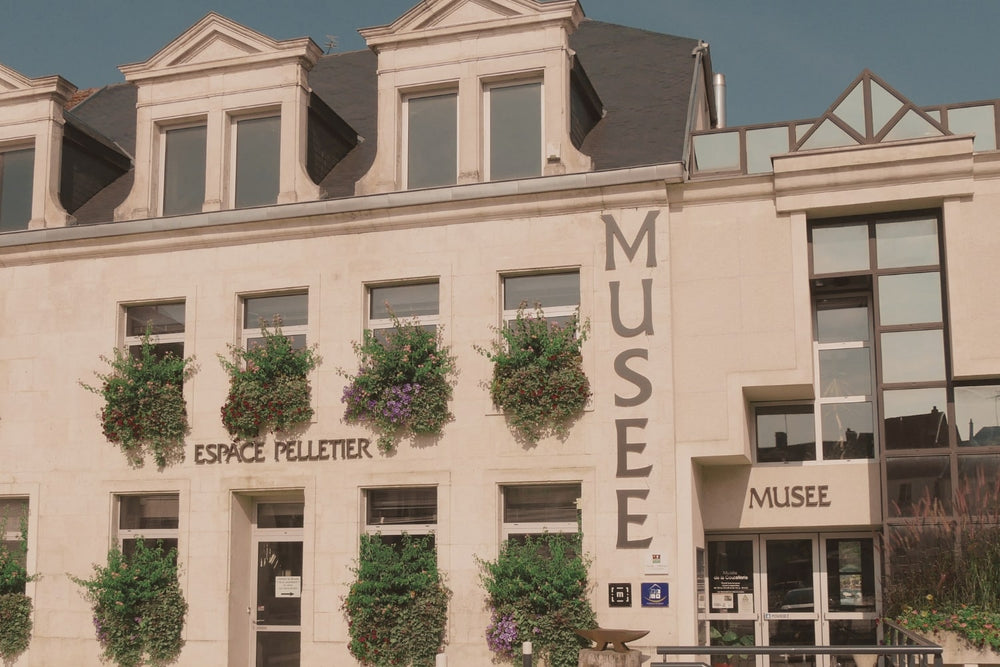
The Nogent museum is now an essential destination for anyone wishing to understand this fascinating history. It preserves period tools, masterpieces created by master craftsmen, and maintains the technical memory of this exceptional cutlery-making region.
The last remaining artisans and iconic businesses
Several renowned companies and artisans continue to produce in and around Nogent, proudly upholding the standards of quality and local tradition. Brands like Nogent*** perpetuate this heritage, particularly in the field of high-quality kitchen utensils and scissors.
Transmission: the role of the vocational high school
As a sign that this heritage is very much alive, the vocational high school in Nogent has a section dedicated to the cutlery and toolmaking trades. It continues to train new generations of skilled craftspeople and workers, thus ensuring that this unique expertise is not lost.
What is a "Nogent" knife today?
Today, the term "Nogent knife" often refers to a very classic and recognizable style of kitchen knife. It typically has a wooden handle, a round bolster, and a slightly curved "yatagan"-shaped blade. It symbolizes the classicism and functional quality that have made the region famous.
Conclusion: Nogent, more than a story, a cutler's soul
Ultimately, the history of Nogent cutlery is one of rural expertise that has risen to the highest peaks of excellence and precision. It is also a story of resilience in the face of the challenges of industrialization and globalization.
Nogent is therefore not simply a memory of the past. It is a living testament that reminds us of the value of manual labor, the precision of each movement, and uncompromising quality. Every pair of scissors or every knife that still carries within it the spirit of Nogent today is the proud custodian of a heritage of over 600 years of exceptional craftsmanship.



This site is protected by hCaptcha and the hCaptcha Privacy Policy and Terms of Service apply.