

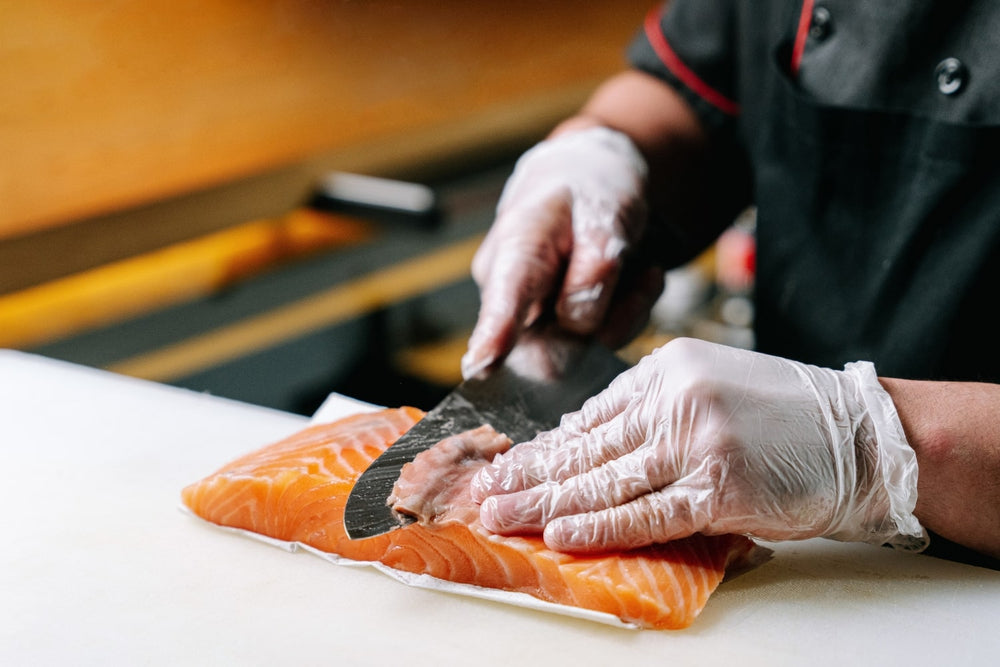
How to use a Deba knife effectively
Using a Deba knife is essential for mastering fish preparation in traditional Japanese cuisine. Once you understand its robust construction, asymmetrical edge, and how it combines power and precision, you can fillet, slice, and dice effectively. This comprehensive guide walks you through each step of using this iconic knife with complete mastery.
Understand the Deba before using it
Before learning how to properly handle a Deba, it's essential to understand its shape, function, and philosophy. This traditional Japanese knife was designed to process whole fish: removing the head, opening the fish, separating the fillets, removing bones, and making precise cuts. Its unique design allows it to handle tasks that other Japanese knives cannot.
The Deba stands out due to its thickness, weight, and asymmetrical edge. It combines the strength of a cleaver with the precision of a Japanese chef's knife. Understanding this duality helps avoid mistakes and adopt the correct techniques.
Why is the Deba so special?
Its shape reflects a specific culinary intention: to precisely cut whole fish . Its fine point is used for delicate movements, while the back part of the blade supports the cutting of thin bones.


Technical specifications of the Deba
The following table helps you understand the elements that make the Deba unique:
| Element | Description | Utility |
|---|---|---|
| Blade thickness | 4 to 9 mm | Resistance and power |
| Simple bevel cutting edge | Bevel on one side only | Precise and guided cutting |
| Notable weight | Heavy blade | Stable and clean cut |
| Solid tip | Triangular shape | Controlled penetration |
| Variable lengths | 15 to 21 cm | Suitable for different sizes of fish |
| Reinforced back | Rigid structure | Can cut thin bones |
Each element contributes to the Deba's versatility in handling fish. Its weight naturally guides the cut, while its sharp edge allows for clean cuts.
Why is technique essential with a Deba?
Using a Deba knife is nothing like using a chef's knife or a Western knife . Its thick blade requires a specific technique to avoid damaging the fish or injuring yourself. Its unique bevel demands precise angle when cutting.
The Deba knife excels when the hand guides the blade with control. Incorrect technique can cause cracks, tearing, or an incorrect angle. Proper technique allows you to channel the knife's power.
The advantages of good mastery
- Precision in separating the fillets
- Better respect for the fish flesh
- Clean cut of the head and fine bones
- Less risk of skidding thanks to the weight
- Improved edge durability
- Increased comfort during handling
The correct handling of the Deba
The grip is a fundamental element. As with all Japanese knives with a single bevel, the position of the hand directly influences the cutting direction.
Since the Deba is heavier than most Japanese knives, a balance must be found between firmness and flexibility of the wrist.
Dominant hand position
- Place your thumb on the handle, slightly forward.
- Position your index finger on the back of the blade to stabilize the angle.
- Wrap the handle with the other three fingers.
- Keep your wrist aligned with the blade to maintain a constant angle.
Role of the guiding hand
The guide hand stabilizes the fish and facilitates cutting. It must be positioned securely.
- Keep your fingers slightly curved.
- Place your hand firmly but without excessive pressure.
- Keep the guide hand still while the blade is working.
- Make sure the surface of the fish remains completely dry.
Mastering the essential Deba movements
The Deba requires several specific movements depending on the stage of fish preparation. Each movement utilizes a different part of the blade.
The three main areas of the Deba
| Blade area | Function |
|---|---|
| Point | Delicate cuts, precise incisions |
| Medium | Threading, clean separations |
| Heel | Powerful cuts, fine edges |
Step 1: Remove the fish's head
- Place the heel of the blade behind the fish's head.
- Use the weight of the knife rather than the strength of your arm.
- Make a firm but controlled movement.
- Cut along the central edge by pressing vertically.
Step 2: Open the fish
- Make an incision at the tip on the ventral line.
- Slide the blade gently to avoid tearing the flesh.
- Avoid excessive pressure.
Move 3: Lifting the nets
- Place the tip against the dorsal ridge.
- Slide the blade in with a smooth motion.
- Follow the shape of the edge without cutting it.
- Use the center of the blade to advance.
Step 4: Remove the edges
- Use the heel of the blade.
- Press firmly but without hitting.
- Slice through the thin bones in one swift motion.
Preparing fish with a Deba: the complete method
1. Pre-cleaning
- Rinse the fish quickly.
- Dry it to prevent any slippage.
- Use a stable board.
2. Removal of the head
Use the recommended technique to remove the head cleanly.
3. Ventral incision
The tip of the Deba is used to gently open the fish.
4. Threading on both sides
- Stick the blade against the dorsal ridge.
- Slide the blade along the bone.
- Use long, sweeping motions.
5. Removal of remaining edges
Use the thick part of the blade to cut the edges.
6. Final cleaning of the nets
Remove membranes and small imperfections.
Common mistakes to avoid with a Deba
| Error | Consequence | Solution |
|---|---|---|
| Too much force | Tear the fish apart | Use the weight of the knife |
| Wrong angle | Irregular cut | Align the bevel |
| Sudden pressures | Lack of precision | Controlled movements |
| Wrong blade area | Inconsistent result | Choose the right area |
| Wet Fish | Dangerous slips | Dry thoroughly |
Essential maintenance of the Deba
Sharpening adapted
- 1000 grit water stone for sharpening.
- Stone 3000 then 6000 for the finishing.
- Strict adherence to the bevel.
- No excessive pressure.
- Rinse and dry immediately.
Cleaning and storage
- Wash by hand only.
- Wipe immediately.
- Store in a wooden saya.
Comparison: Deba vs. other Japanese knives
| Knife | Use | Special feature |
|---|---|---|
| Deba | Whole fish | Thick and powerful |
| Yanagiba | Fine threading | Long and thin |
| Usuba | Vegetables | Vertical section |
| Gyuto | Versatile | Double bevel |
Advanced use of the Deba
Angle adjustment
- Maintain a slight tilt.
- Maintain wrist orientation.
- Stabilize the blade during cutting.
Weight control
- Let gravity do its work.
- Maintain a consistent motion.
- Reduce fatigue by only guiding.
Tips for making rapid progress
- Practice on small fish.
- Sharpen often.
- Work slowly to understand the angle.
- Always dry the work surface.
- Keep a steady guide hand.
Conclusion
Learning how to use a Deba knife requires patience, precision, and an understanding of the traditional structure of this Japanese knife . Thanks to its thick blade, unique bevel, and precise weight, it allows you to prepare a whole fish efficiently and expertly. By applying the appropriate techniques and properly maintaining the blade, you can transform this knife into an indispensable tool in your kitchen.
FAQ
1. Can the Deba be used to cut bones?
Yes, but only for thin edges and light bones. The thick back of the blade allows for controlled pressure. However, it should never be used as a heavy cleaver to avoid damaging the edge and breaking the blade.
2. Is the Deba suitable for beginners?
Yes, the Deba can be suitable for beginners provided they follow the essential techniques. Its weight helps guide the movements, but it requires a certain degree of precision to avoid damaging the fish. With practice, it becomes very intuitive.
3. What size Deba should I choose to start with?
A 16-18 cm blade is an excellent choice for beginners. It remains easy to handle while offering enough length to tackle most fish. A blade that is too large can make it difficult to grip at first.
4. Can a Deba be used for meat?
The Deba can occasionally be used for cutting tender meat or small poultry, but that is not its primary function. It remains designed mainly for fish, and improper use can damage its edge.
5. How do I know if I'm using the correct cutting angle?
The correct angle is indicated by the smoothness of the cut. If the blade advances without resistance and the cuts remain smooth, the angle is correct. If there are any tears, slightly adjust the bevel angle and stabilize your wrist further.



This site is protected by hCaptcha and the hCaptcha Privacy Policy and Terms of Service apply.