

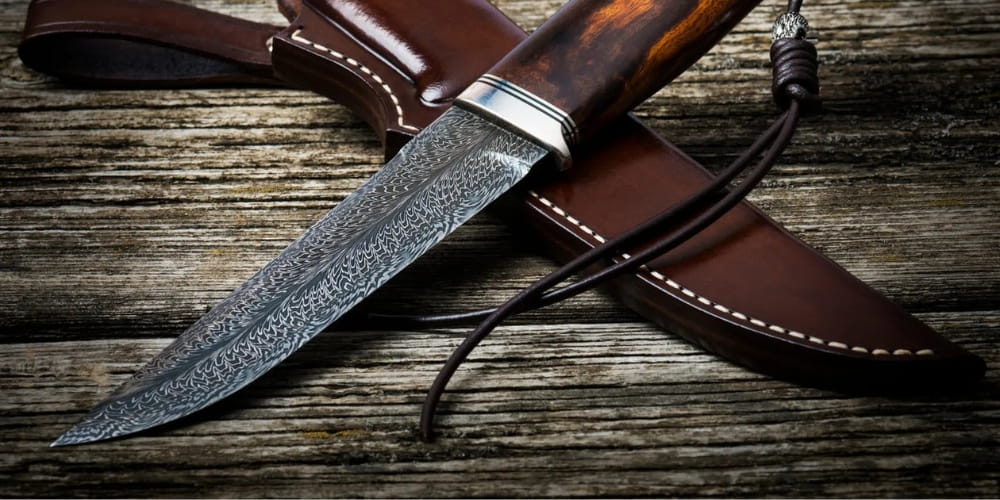
Damascus steel: origin, composition and manufacturing
Damascus steel is a legendary metal alloy known for its characteristic wavy patterns and exceptional cutting and strength properties. Its history stretches back centuries, with origins often attributed to Indian blacksmiths via wootz steel, later perfected in the Middle East, particularly in Damascus, hence its name.
Historical origin
Damascus steel takes its name from the Syrian city of Damascus , a major trading center in the Middle Ages where these blades were imported and prized by European crusaders for their apparent superiority over local weapons. However, its true origin dates back to ancient India, around the 3rd century BC, where it was produced as wootz steel, a high-carbon steel obtained by crucible smelting. This steel traveled via Persian and Arab trade routes, reaching Damascus in the 8th-11th centuries, where Arab smiths worked it to create legendary swords like the shamsir. 11th-century Arabic texts already mention the addition of specific minerals to improve its quality, and its reputation as a "living metal" stems from its ability to remain flexible while being extremely sharp. Why this Indian origin? Because modern analyses reveal impurities typical of Indian vanadium-rich ores, absent elsewhere, explaining the unique patterns formed during forging.


Chemical composition
Contrary to popular belief, genuine Damascus steel is not simply a composite of modern steels (such as carbon and stainless steel , common in current reproductions). The original is a hypereutectoid steel with more than 1% carbon (often 1.5 to 2%), produced by the slow crucible smelting of pure iron with charcoal, forming iron carbides (cementite) and traces of elements such as vanadium, molybdenum, or manganese from Indian wootz ores (like "magnesia nigra"). These microscopic impurities (ceramide nanoparticles) create damask patterns during cooling through light diffraction, giving the illusion of waves or flowers. The typical composition is approximately 98-99% iron, 1-2% carbon, with less than 0.5% alloying impurities that stiffen the matrix while allowing for selective hardening, resulting in an exceptional edge without brittleness. For a novice, imagine it like a chocolate pudding: the iron is the fluid cream, the carbon the hard lumps that disperse unevenly, creating texture and strength.
Manufacturing process
Traditional manufacturing begins with the production of wootz ingots: soft iron is smelted with charcoal in a sealed clay crucible at 1200-1500 °C for 24-48 hours, allowing for the slow diffusion of carbon without oxygen bubbles (crucial for preventing brittleness). Once cooled, the ingot is hot-forged (650-850 °C) by repeated folding and hammering (up to 200 layers), aligning the cementite bands to create the patterns visible after acid polishing. The final quench in water or brine hardens the cutting edge (via martensite) while the back remains ductile (pearlite), offering a perfect balance between cutting and bending. This know-how was lost around 1750 due to the depletion of specific wootz ores, but modern manufacturers imitate it by twisting packs of alternating steels, without the original nanoparticles. Step by step, it's like kneading puff pastry: each fold incorporates more layers, and the heat reveals the magical structure through atomic migration of the carbides.
Modern Properties and Uses
Thanks to its aesthetic patterns and hardness (up to 62 HRC at the edge), Damascus steel excels for blades: from ancient medieval swords to katanas, kitchen knives , and high-end tools today. Its wear resistance comes from the alternating soft and hard layers, making it more impact-resistant than homogeneous steel. Contemporary reproductions (forged Damascus steel) use 100-500 layers for aesthetic purposes but often lack the historical performance due to the absence of impurities. To understand why it was so captivating, try it: an authentic Damascus blade can effortlessly slice through flying silk, thanks to its nanometric microstructure that disperses stress like a fishing net absorbs waves.



This site is protected by hCaptcha and the hCaptcha Privacy Policy and Terms of Service apply.