

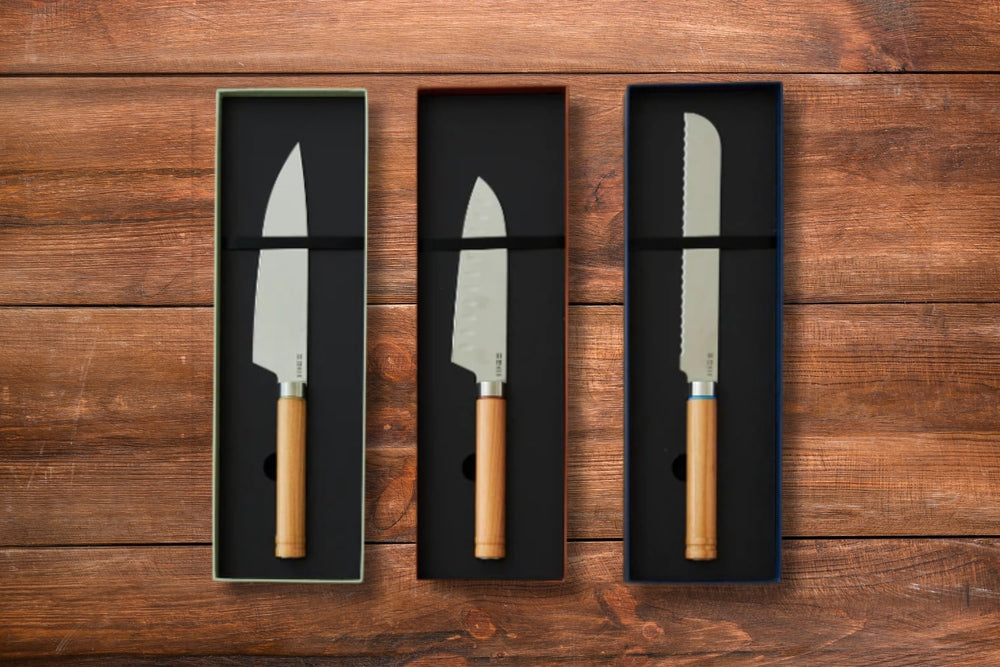
The 3 essential knives in the kitchen
The three essential knives in the kitchen, covering approximately 90% of daily cooking tasks, are indeed the chef's knife (or paring knife), the utility knife, and the bread knife (or serrated knife), as you accurately describe, drawing inspiration from chefs like Philippe Etchebest. These tools form a balanced trio because they utilize distinct biomechanical principles: the balance for handling large items, tactile precision for details, and the serrations for tough textures, allowing you to manage meats, vegetables, breads, and more without unnecessary tools.
Chef's knife (slicing knife, 20-25 cm)
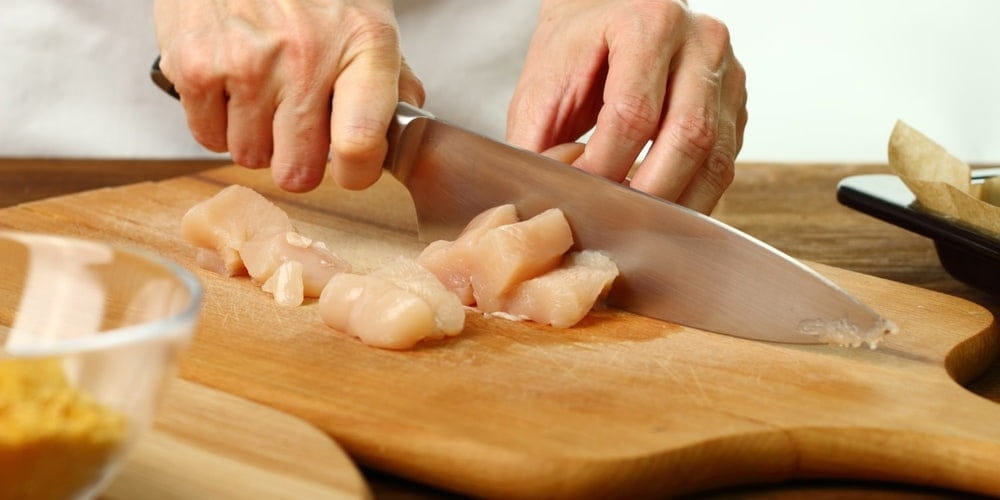
This knife is the backbone of any kitchen, with its wide, curved, and robust blade that allows for a rocker motion (heel-to-tip swing). It enables you to dice onions, chop herbs, slice meat, or mince vegetables with a fluid rhythm, thanks to the perfect balance between handle and blade that distributes the effort to the forearm rather than the wrist. Its versatility stems from its geometry: the thick heel for tough ingredients, the fine tip for pivoting, making many other tools unnecessary for intensive household use.


Utility knife (7-12 cm)
A marvel of maneuverability, its short, pointed, and rigid blade excels in precise tasks where brute force is counterproductive, such as spiralizing a potato, turning a vegetable into an olive, removing the seeds from a pepper, or finely zesting zest. The "pincer" grip (thumb and forefinger on the blade) offers millimeter-precise control, essential for avoiding waste and creating decorations effortlessly, as its lightness requires only the fingers. It is the tool for meticulous preparations that transform a simple dish into a refined work of art, justifying its indispensable place even among professionals.
Bread knife (serrated blade, 20-30 cm)
Its long, serrated blade (often 25 cm) is designed to penetrate hard crusts without compressing the tender interior, making it ideal for rustic bread, brioches, but also ripe tomatoes, moist cakes, or thick-skinned citrus fruits. The alternating teeth (Japanese or Western saw) create a "scratching" effect that grips the rough surface while gliding over the flesh, with long, quick strokes rather than pressure; this preserves juices and textures, explaining why it outperforms a smooth knife on these hybrid textures.
Professional option: sole fillet as an alternative
As noted by Etchebest, a filleting knife (flexible blade 18-20 cm) can replace a bread knife for cooks who focus on fish: its flexibility follows the dorsal bones to create perfect fillets of sole or salmon, and its thinness slices tender vegetables or meats cleanly without damaging the texture. Choose this option if your dishes feature seafood; otherwise, a bread knife is more suitable for everyday tasks like cutting tomatoes or bread.
Comparative table of tasks covered
| Knife | Main tasks (90% coverage) | Key move | Typical ingredients |
|---|---|---|---|
| Chef/Slicer | Chop, mince, slice large volumes | Rocker | Vegetables, meats, herbs |
| Automatically | Peel, turn, fine precision | Pinch point | Fruits, small vegetables, decorations |
| Bread (or fillet) | Hard crusts, mixed textures/fish | Smooth sawing/bending | Bread, tomatoes, flatfish |
Maintenance for optimal longevity
Sharpen them to 15-20° with a whetstone or honing steel (for the chef and weekly use, and for occasional bread), hand wash to preserve the steel (Wüsthof or Sabatier are recommended), and store them on a magnet or block to prevent damage. Understanding their ergonomics reveals why this trio is all you need: each blade optimizes a specific cutting phase (penetration, propulsion, separation), transforming cooking into a precise science rather than brute force. With these tools, you can go from novice to efficient cook by mastering one technique per tool.

,%20the%20utility%20knife,%20and%20the%20bread%20knife%20(or%20serrated%20knif...)
This site is protected by hCaptcha and the hCaptcha Privacy Policy and Terms of Service apply.