

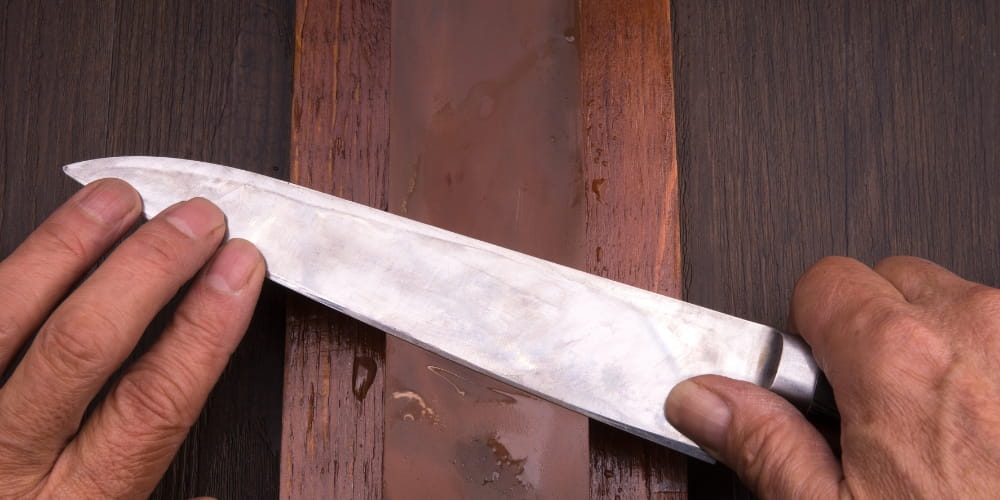
How to sharpen a knife with leather
Sharpening a knife with leather, or "stropping," is a professional finishing technique that hones the edge to a razor-sharp level after sharpening with a whetstone or an emergency honing, such as with aluminum foil. Unlike previous abrasive methods (fork, plate, aluminum foil), leather doesn't scrape but polishes the edge by aligning the micro-serrations and removing residual burrs, ideal for restoring the precise geometry of a 15° Japanese knife without removing any metal. It's the ultimate step for a surgical edge that shaves hairs effortlessly, extending the time between 6000-grit whetstone sessions.
Why does leather excel in final polishing?
Natural leather (calfskin, horsehide) has a smooth, porous surface that traps the fine steel particles lifted by the stone, acting like a molecular magnet to straighten the sharp edge—imagine polishing a mirror with a soft cloth rather than sandpaper. For hard blades (60+ HRC like Japanese VG-10), it prevents scratches and creates a mirror bevel, improving glide through fibrous foods without altering the asymmetry (90% front, 10% back). With a polishing compound (green for heavy-duty work, white for finishing), the loaded abrasive boosts the effect, equivalent to a natural 10,000+ grit.


Choosing the leather and simple preparation
Choose a flat strop, 30-40 cm long, made of thick (2-3 mm) vegetable-tanned leather, fixed to a stable wooden board – an old belt or a piece of oiled leather will do in a pinch. Clean it with isopropyl alcohol to remove accumulated grease and metal; apply a thin layer of honing compound (the size of a pea, green Dialux for beginners) by rubbing it in with your finger until evenly absorbed. Do not soak the leather: it must remain dry and taut like a drumhead. For beginners, fix it with the grain facing up; test your blade on paper – if it already catches, it's perfect for this post-sharpening step.
Precise technique: movements and angle
Hold the strop still, knife at exactly 15° (slightly more open than with a whetstone, ~12-15° for asymmetrical Japanese knives – check visually or with a coin). Back of the blade facing the leather (edge upwards to avoid cutting the leather!).
Push the heel towards the tip, gently pulling towards you (a light "forward" or "X" motion), applying almost no pressure, like stroking a cat: 5-10 slow strokes per side. Alternate strictly, feel the blade "float" without any grinding – the burr disappears in 20 seconds. For the Japanese asymmetry, 8 strokes on the front, 2 on the back; finish with 5 free strokes in the air to "seal" the cut. Repeat until the blade shines and shaves a damp hair without pulling.
Tests and interviews for a professional result
Check with a finger perpendicular to the surface: silky smooth grip without pricking; tomato that opens on its own; razor paper that "sings." If burr residue remains, go over the surface 3 times. Clean the strop afterward with a dry cloth, and reapply the paste every 2-3 uses. Frequency: weekly after sharpening, or daily for quick maintenance – transforms your aluminum/plate hacks into a mirror-like edge!
Limitations and errors to avoid
Leather strops won't restore a dull blade (always start with a 1000-grit stone or hacks): they polish, not abrasion, and strops will only dull it further. A fatal mistake: avoid applying too much pressure (it dulls the edge) or pointing the edge downwards (it tears the leather). Not suitable for pure ceramic. A perfect addition to your arsenal: a pro stone + strop = an invincible kit. Any tips using ground coffee or a paddle strop next? Let me know!


This site is protected by hCaptcha and the hCaptcha Privacy Policy and Terms of Service apply.