

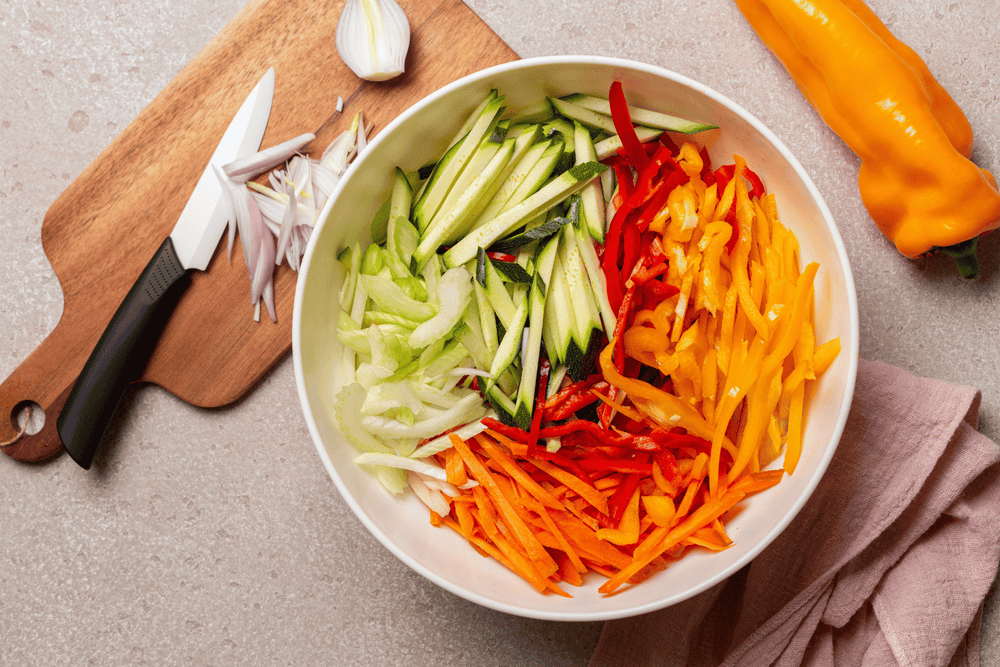
How to julienne vegetables
Julienne vegetables might seem like an art reserved for chefs, but rest assured, with a little practice, you'll be able to do it without any trouble. Imagine the satisfaction of preparing a salad, a side dish, or even a soup with vegetables cut into finely even strips, ready to impress your guests! So, how do you master this technique? Let me guide you step by step. You'll see, it's not rocket science, just a matter of organization and the right technique.
Prepare your equipment
Before you start julienne-cutting, it's essential to have the right tools on hand. You'll need a sharp knife (a chef's knife is perfect for this), a stable cutting board, and of course, your fresh vegetables. Let's face it, cutting vegetables with a dull knife is not only frustrating but also dangerous. In fact, I don't know about you, but I've ended up squashing my vegetables instead of slicing them... Not very practical, is it?


Choose your vegetables
The most common vegetables to julienne are carrots, zucchini, bell peppers, and cucumbers. You can also try it with beets or potatoes, depending on the recipe you're making. Let's take carrots as an example, a classic. Their firm texture makes them ideal for practicing. By the way, here's a little tip: choose straight, firm vegetables; it's much easier to get uniform julienne strips. Nothing's worse than starting with a crooked cucumber or a limp carrot!
Cut your vegetables into even segments.
The key to perfectly julienne vegetables is consistency. Start by cutting your vegetables into segments 5 to 6 cm long (this will depend, of course, on the vegetable and the recipe). If the shape of the vegetable allows, as with a carrot, first cut it in half lengthwise to create a flat base, which will prevent it from rolling on the cutting board. Then, slice each segment into thin strips 1 to 2 mm thick.
For example, with zucchini, I prefer to first slice them lengthwise into thin strips, then stack them before cutting them into thin ribbons. It takes a little patience, but it's worth it! Just think of your future guests who will be amazed by the presentation of your dishes.
Cut into sticks
Once your thin slices are ready, carefully stack them. The goal is to cut strips the same width as the previous slices, about 2 mm. The key is to maintain a consistent size. The thinner and more uniform the strips, the better your julienne will be.
A little personal anecdote: when I learned this technique, I was so focused on precision that I forgot to savor the moment! Remember that cooking is first and foremost a pleasure, even if it requires concentration. Relax and enjoy each step.
One last piece of advice: take your time
At first, you might feel a little clumsy. That's normal. The secret is patience. The more you practice, the more precise and faster your movements will become. If you're in a hurry, you can use a mandoline, but I recommend mastering the manual technique. It's much more rewarding.
And let's face it, there's a certain pride in seeing these beautiful sticks perfectly aligned, ready to be used in a salad or stir-fry!



This site is protected by hCaptcha and the hCaptcha Privacy Policy and Terms of Service apply.