

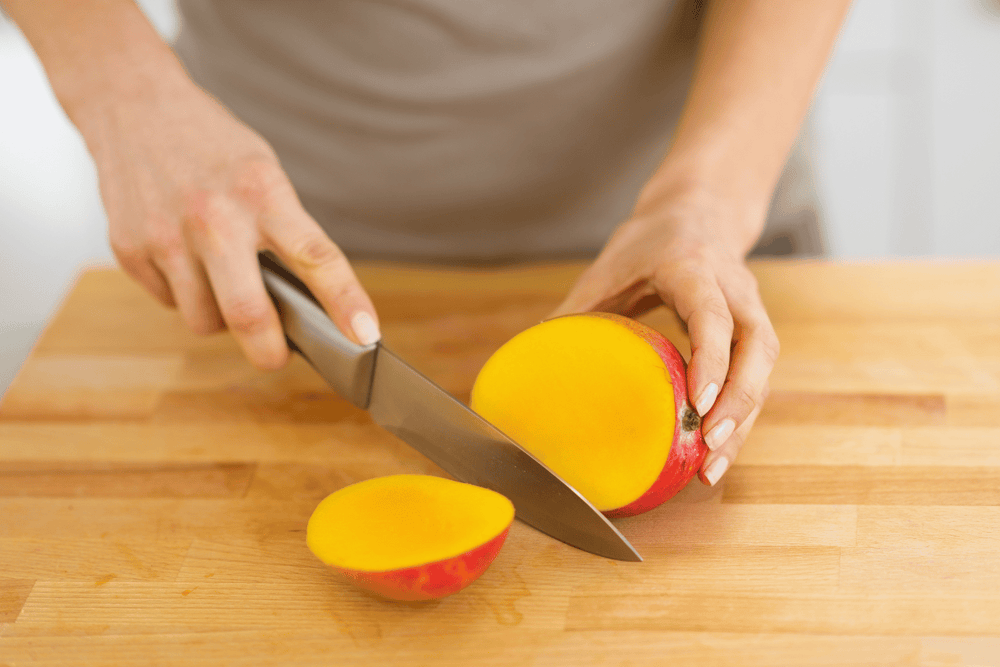
How to cut a mango easily and quickly
Cutting a mango easily and quickly is possible with simple techniques that avoid waste and minimize effort. These methods take advantage of the flat, wide pit to separate the flesh without directly touching it. They are suitable for a ripe mango that is soft to the touch.
Understanding the structure of the mango
The mango has a flat, oval pit in the center, making it easy to cut once you've located it. Before cutting, position the mango vertically and locate the pit by feeling its shape under the skin. This prevents you from touching it with the knife, preserving more juicy flesh and reducing the risk of slipping due to the juices. Use a stable, ideally non-slip, cutting board and a sharp knife for safety and precision.


First common step: separating the cheeks
All methods begin by slicing the mango into three sections. Stand it upright on its narrow base, then insert the knife flat on either side of the pit to create two fleshy "cheeks" and a thin middle section containing the pit. This cut follows the oblong shape of the pit, which is approximately 20-30 cm long depending on the variety, thus preventing the loss of valuable pulp. Rinse the mango beforehand for optimal hygiene.
Classic method: hedgehog effect
On each cheek, score the flesh in a grid pattern with horizontal and vertical lines, without piercing the skin, creating a checkerboard effect. Fold the skin outwards, pushing from underneath to create a "hedgehog" effect. Then, detach them with a spoon or knife: this easily releases the perfect pieces for salads or smoothies in less than 2 minutes. This technique is ideal for beginners as it clearly shows the portion sizes.
Ultra-fast method: with a glass
Make a small notch at the end of a mango cheek without piercing the flesh. Position this notch on the rim of a tall, thin glass, flesh side down, then gently press downwards: the skin will separate on its own and the pulp will fall directly into the glass. Perfect for very ripe mangoes, this trick avoids any contact between hands and flesh and cleans up in one go, in barely 30 seconds. Use a sturdy glass to prevent breakage.
Other quick variations
For slices, peel the cheeks with a vegetable peeler and then slice lengthwise. If you have a mango corer (a specific tool), it removes the pit with a single press, but without one, prioritize the methods above to avoid using extra equipment. Avoid peeling the entire mango first, as the flesh slips and bruises easily; always cut with the skin on for a better grip. These tips maximize yield: an average mango gives 150-200g of net flesh.


This site is protected by hCaptcha and the hCaptcha Privacy Policy and Terms of Service apply.