

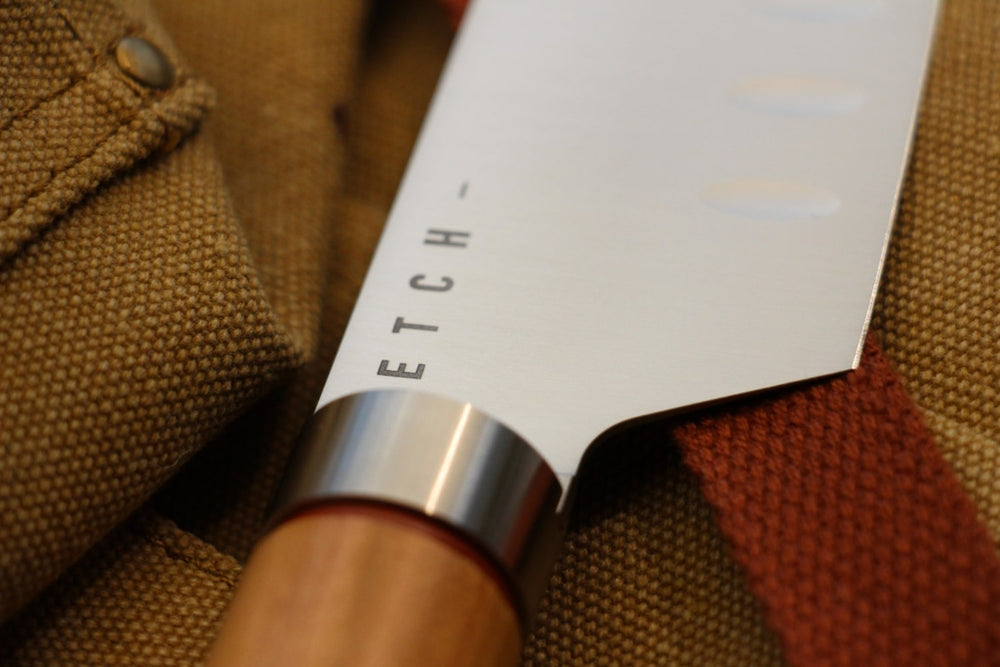
How to choose and use a chef's knife
To properly hold a chef's knife, place your thumb and forefinger in a pincer grip on the blade, just before the guard. Your other fingers should grip the handle. Use a rocking motion for chopping and a clean, sweeping motion for slicing. Avoid twisting, hard surfaces, and sudden movements.
Want to know how to choose and use a chef's knife? This tool is the cornerstone of any kitchen, from the home cook to the professional. Versatile, powerful, and precise, it's the perfect companion for almost all your culinary creations.
In this article, you'll discover the criteria for selecting a chef's knife suited to your needs, the correct way to use it, cutting techniques to master, and mistakes to avoid. You'll also find a comparison chart of models and a handy FAQ.
What is a chef's knife?
Before buying, it's important to understand what distinguishes this knife from others. A chef's knife is a large kitchen knife with a blade 20 to 25 cm wide. Designed for chopping, slicing, and mincing, it's the most versatile tool in the kitchen. Its weight and size give it power and precision.


The advantages of a chef's knife
A good chef's knife quickly becomes an indispensable companion in the kitchen.
- Versatility: vegetables, meats, herbs, fish… it can do everything.
- Efficiency: its large blade allows for quick cuts.
- Note: the curvature of the blade promotes the pendulum motion.
- Durability: A quality knife that is well maintained lasts for years.
The essential criteria for making the right choice
Certain technical details make all the difference between an ordinary knife and a true chef's knife.
- Blade length: between 20 and 25 cm, depending on your comfort level.
- Weight: a heavier knife helps to cut cleanly, but is more tiring.
- Balance: the weight distribution between the blade and the handle ensures comfort and control.
- Steel: choose between European stainless steel (56–58 HRC, tolerant) and Japanese steels (60–62 HRC, sharp but brittle).
The different types of chef's knives
Each culinary tradition has developed its own version of this iconic knife.
- European chef's knife : thicker blade, robust, ideal for all uses.
- Japanese Gyuto knife: thinner blade, razor sharp, perfect for precision.
- Santoku knife : shorter and lighter, it is suitable for small hands or quick movements.
Comparative table of chef's knives
| Kind | Blade length | HRC Hardness | Strengths | Boundaries |
|---|---|---|---|---|
| European chef | 20–25 cm | 56–58 HRC | Versatile, robust, tolerant | Less sharp than a Japanese |
| Japanese Gyuto | 20–24 cm | 60–62 HRC | Sharp edge, thin cut | More fragile to impacts |
| Santoku | 16–20 cm | 58–60 HRC | Maneuverable, lightweight, precise | Less suitable for large volumes |
How to use a chef's knife
Mastering a chef's knife means learning to exploit its full potential.
When to use a chef's knife
Knowing when to take it out of the drawer is part of using it properly. A chef's knife is used for chopping vegetables, cutting boneless meat, mincing herbs, and slicing fruit. For filleting fish or deboning poultry, use a specialized knife.
How to hold a chef's knife correctly
A proper grip is essential for both safety and precision. Grip the handle firmly, with your thumb and forefinger resting on either side of the blade, just behind the guard. Your other three fingers should wrap around the handle. This "pincer" grip ensures control and power.
The main cutting techniques
- Rocking motion: ideal for chopping herbs and vegetables.
- Clean cut: from heel to toe for meats and fish.
- Slicing: thin, even slices, perfect for onions or garlic.
- Chopping: blade raised then lowered quickly, always in rhythm.
Common mistakes to avoid
A chef's knife that is used incorrectly loses its effectiveness and can become dangerous.
- Cutting on glass or marble: it dulls the blade.
- Forcing bones: risk of breaking or chipping the steel.
- Washing in the dishwasher: heat and products damage steel and handle.
- Neglecting sharpening: a dull blade requires more effort and slips.
How to care for your chef's knife
Proper maintenance keeps your knife performing well and lasting.
- Clean it by hand immediately after use, then dry it.
- Store it in a block or on a magnetic bar, never loose.
- Sharpen it regularly with a ceramic sharpening steel.
- Sharpen it with a whetstone as soon as the sharpening is no longer sufficient.
Ideal recipes using a chef's knife
A chef's knife radically changes the experience of certain preparations.
- Ratatouille : regular cutting of the vegetables.
- Roast chicken : clean and precise slicing.
- Homemade sushi: clean cut of the raw fish.
- Mixed salads: quick chopping of vegetables and herbs.
You now know how to choose and use a chef's knife. This tool is much more than just a knife: it's an extension of your hand in the kitchen.
Choose a model that suits your style, maintain it carefully, and learn how to use it correctly. You'll gain efficiency, safety, and enjoyment in cooking.
FAQ
What blade length should a chef's knife be?
Between 20 and 25 cm, depending on your preference. To choose and use a chef's knife properly, adapt the size to your comfort.
What HRC hardness rating is appropriate for a chef's knife?
Between 56 and 58 HRC for a European knife, and 60–62 HRC for a Japanese one. The HRC hardness rating helps in choosing and using a durable chef's knife.
What is the difference between a Gyuto and a European knife?
The Gyuto knife is thinner and sharper, but fragile. The European chef's knife is more robust. Two ways to choose and use a chef's knife.
How to sharpen a chef's knife?
Includes a ceramic honing steel for regular maintenance and a sharpening stone to restore a razor-sharp edge. Essential for properly using a chef's knife.
Can a Santoku replace a chef's knife?
No, it complements. Shorter and more maneuverable, the Santoku is suitable for small cuts, while the chef's knife remains more versatile.



This site is protected by hCaptcha and the hCaptcha Privacy Policy and Terms of Service apply.