


History of the knife: a blade through the ages
Imagine yourself for a moment, deep in nature, without a phone, without electricity… just you, your hands, and a knife. This simple object, which we often take for granted, has nonetheless accompanied us through the centuries, shaping our history and our survival. But where does this knife really come from? How did it become this versatile and indispensable tool? I invite you to discover the fascinating history and evolution of the knife , from legends and traditional craftsmanship to modern innovations.
The knife, that faithful companion since prehistoric times
Let's take a moment to travel back in time. Did you know that the very first knives were made of stone, more specifically flint? These prehistoric blades , although rudimentary, were incredibly effective. It's often said that "necessity creates the tool," and that's exactly what happened. Prehistoric people used these blades to slice meat, cut hides, and even defend themselves.
And when you think about it, it all seems quite logical, doesn't it? After all, before supermarkets and stainless steel kitchen knives, you had to find a way to cut and prepare your food. Just thinking about it makes me grateful to have a well-equipped kitchen today (with a good, sharp knife, of course!).


The transition to the Bronze Age: a sharp revolution
You may have heard about the Bronze Age in school, but did you know that it was during this period that the knife truly began to take shape? We went from fragile flint blades to more durable blades better suited to a multitude of tasks. Imagine the surprise of the early craftsmen who saw how much stronger and sharper this material was than anything they had ever known!
It was also during this period that a true passion for cutlery was born. Blacksmiths (who could be compared to the rock stars of the time!) perfected their craft, creating knives not only for hunting, but also for war and sacred rituals. What's fascinating is that some of these artisanal manufacturing techniques still survive today, particularly in specialized towns like Thiers in France or Solingen in Germany.
Incidentally, here's a little anecdote: I have a friend who's passionate about hunting knives, and he once showed me an old family knife made of Damascus steel . The blade, with its wavy pattern, was a true masterpiece. It was almost too beautiful to use! But according to him, a good knife is meant to be tested, not just admired.
The Iron Age and the emergence of mythical blades
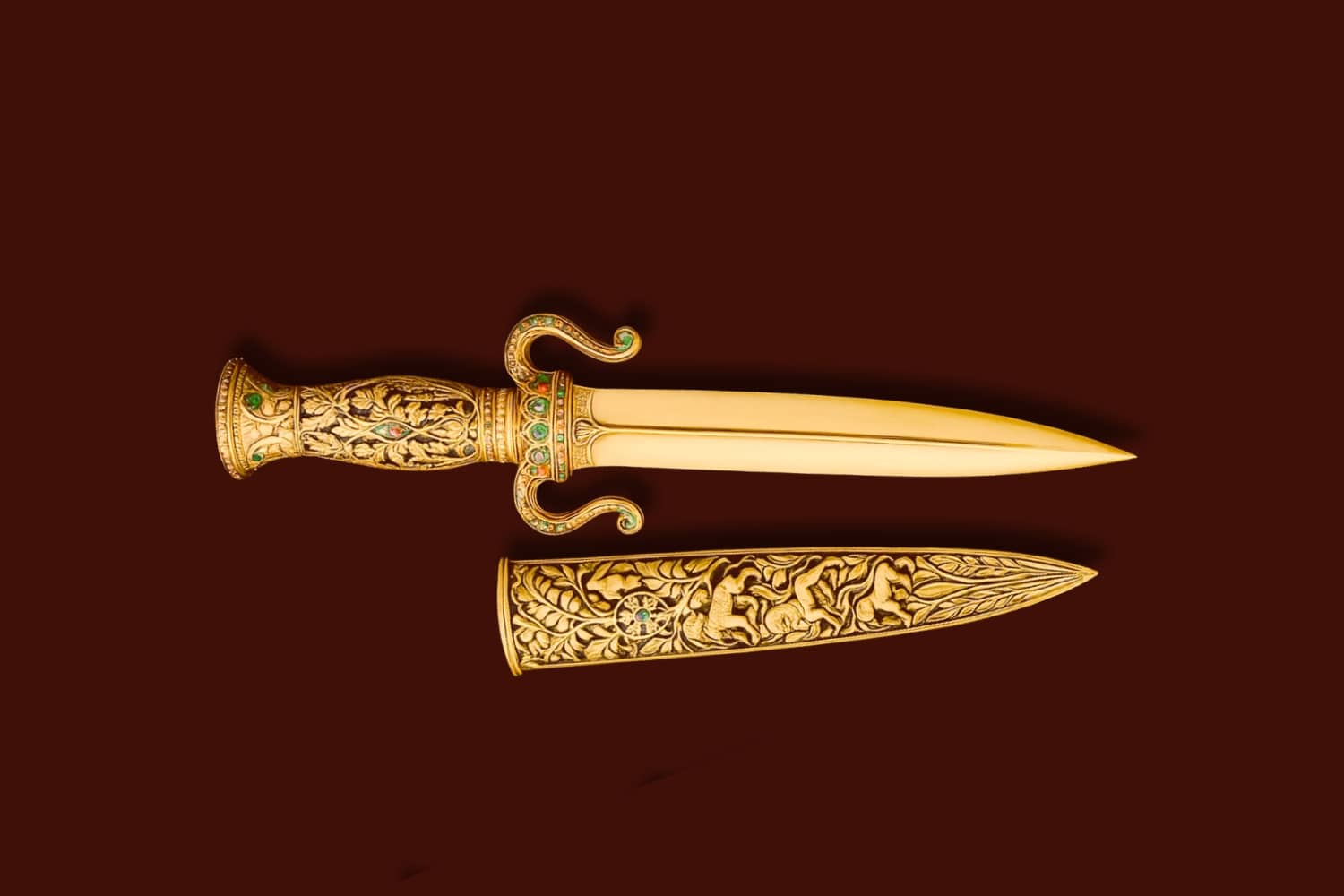
With the advent of the Iron Age , renowned blacksmiths reached new heights. Blades became sharper , stronger, and frankly, far more impressive! Think of Viking knives or the ancient daggers of Roman civilizations... These objects were much more than utilitarian: they carried within them a whole symbolism of power and prestige.
If you're a history buff, you probably know that military knives played a central role on the battlefield. But did you know that some Roman knives were designed not only for combat, but also for religious ceremonies? These magnificent artifacts can be found in several weaponry museums .
Speaking of museums, I remember a visit to the Louvre where I discovered legendary swords displayed in the ancient arms section. Seeing these blades, so magnificently preserved, made me realize how central the knife, in all its forms, has been to our societies, far beyond its primary use.
Kitchen, hunting and survival knives: blades for all occasions
Today, whether you're a Michelin-starred chef, a passionate hunter , or a hiking enthusiast, there's a knife for every situation. Kitchen knives have evolved into incredibly precise instruments. A good chef's knife can take you from a weekend cook to a true culinary maestro (okay, I'm exaggerating a bit, but you get the idea!).
In a more sporting context, hunting and survival knives are designed to withstand the elements. A friend of mine who enjoys hiking in the wilderness told me an incredible story where his survival knife literally saved his life. He had gotten lost in a forest for several hours and had to use his knife for everything: cutting branches, building a fire, and even defending himself against a wild animal (rest assured, he came out unscathed!).
Have you ever used a knife in an unexpected or delicate situation? If so, I'd be curious to hear your story.
Cutlery making: a craft that transcends time.
There's something incredible about the idea that some renowned blacksmiths continue to practice techniques that are centuries old. This is the case with Damascus steel , used to make blades that are both strong and beautifully crafted. It's almost as if each knife tells a story: the story of the craftsman who forged it, but also the story of the hands that have used it throughout time.
The major cutlery-making cities, as I mentioned earlier, have successfully combined artisanal traditions with innovations in manufacturing . Even today, collections of antique weapons and historical blades are preserved in museums, serving as testaments to this incredible evolution.
A little lightness...
Between us, if you're like me, you probably have a drawer in your kitchen filled with knives: some perfectly sharp, others... how shall I put it... a little dull . And yet, we all have that favorite knife, the one we use all the time, even when it might be wiser to use another. You know what I mean? Well, that too is proof of our attachment to this simple, yet essential, object.
The knife: a symbol of protection, war, and art
Throughout history, the knife has not only been a cutting tool . It has become a symbol of protection , a defensive instrument, and even an object of art. In some cultures, it is synonymous with power. In others, it represents a family heirloom passed down through generations.
For martial arts practitioners, the knife is an extension of the body, a weapon to be mastered with discipline and respect. This symbolism is also found in films, books, and works of art. You have surely seen paintings or artistic representations depicting scenes of war with legendary swords or ancient daggers ...
All this to say, the knife is much more than just an object in our daily lives. It is deeply rooted in our stories, our traditions and our history.
Conclusion: The history of the knife, a timeless blade
If you had to choose one object to accompany you through the ages, what would you choose? I bet the knife would be a strong contender. From flint blades to Damascus steel , including military knives and kitchen knives , this sharp tool has always known how to adapt, evolve, and find its place in every era, every civilization.
And the next time you use a knife to cut a simple tomato, take a moment to reflect on all that it represents: the evolution of materials, the work of craftsmen, and above all, the incredible link between man and his environment.
So, what do you think? Which is your favorite blade and why?
I hope this article has succeeded in bringing the history of the knife to life in a way that resonates with you. Feel free to share your anecdotes or thoughts in the comments. Who knows, perhaps one of your stories will enrich this long journey through ages and cultures!


This site is protected by hCaptcha and the hCaptcha Privacy Policy and Terms of Service apply.